FY26 K-12 Funding: Uncertainty Is Now a Structural Reality
Complexity has always defined K-12 funding cycles. For districts planning for FY26, that complexity has intensified into a structural condition: securing reliable funding in an environment where timing, eligibility, and implementation rules remain fluid.
K-12 funding continues to operate as a layered mix of federal, state, and local dollars. Administrators are accustomed to navigating formula grants, compliance thresholds, maintenance-of-effort requirements, and staggered application windows. What has shifted is the planning calculus. District leaders are no longer asking only “Where is the funding?” They are asking:
- When will funds be released?
- What conditions will govern their use?
- How stable are those allocations across fiscal years?
Federal Uncertainty = Glacial Movement
Recent federal actions have introduced additional variables into the FY26 planning horizon. Legislation signed into law provides $79 billion in funding for the U.S. Department of Education covering February 4 through September 30, including an increase of approximately $217 million over projected FY25 levels, according to reporting from K-12 Dive.
The legislation includes requirements for states and districts to submit on-time formula grant proposals at congressionally dictated levels, while discussions continue around potential reallocation of program responsibilities to other federal departments.
While the education community has expressed measured relief following passage of the bill, execution risk remains a consideration. In a statement following the signing of the Education Budget, the National Association of Secondary School Principals noted that congressional action allows school leaders to focus on students rather than immediate funding concerns, while emphasizing the importance of faithful implementation.
Key Contextual Data Points
- $6.2 billion in federal K-12 funding for FY25 was temporarily withheld in July 2025
- Represented approximately 14.4% of the prior-year Department of Education budget
- Triggered delayed staffing decisions, program rollouts, and long-term planning adjustments across districts
Even temporary withholding events create downstream operational effects, particularly for districts operating with limited reserves.
Infrastructure Pressures Continue to Mount
Funding volatility occurs alongside sustained infrastructure demands.
The State of Our Schools 2025 report ranks K-12 education as second only to highways in total public infrastructure capital outlay nationwide. Much of this investment is financed through long-term debt obligations repaid annually through district operating budgets.
The report characterizes state and federal infrastructure support as varied, unstable, and insufficient relative to need. Federal intervention frequently follows natural disasters or crisis events rather than proactive modernization cycles. FEMA awarded nearly $13 billion in grants to school districts between FY13 and FY23, a substantial figure that nevertheless represents only a portion of ongoing capital requirements.
Facilities modernization, safety upgrades, HVAC systems, technology infrastructure, and compliance-driven renovations require predictable funding streams. Unpredictability complicates multi-year capital planning.
Spending Is Rising Along With Accountability
Despite federal volatility, total K-12 spending continues to trend upward.
Long-Term Funding Trends (2002-2023)
- 35.8% increase in public K-12 funding
- $946.5 billion in total nationwide funding in 2023
- Per-pupil spending increased from $14,969 to $20,322
(Source: Reason Foundation, K-12 Education Spending Spotlight)
Growth in spending has coincided with expanded expectations:
- Enhanced school safety and security responsibilities
- Increased mental health and student support services
- Expanded technology integration and cybersecurity requirements
- Greater oversight, reporting, and compliance accountability
Funding growth does not equate to fiscal flexibility. Many allocations remain restricted, time-bound, or program-specific.
Planning in a Persistent State of Flux
Uncertainty is no longer episodic. It has become a defining feature of the fiscal environment.
For district leaders, this shifts the emphasis toward:
- Diversified funding strategies
- Scenario-based budgeting
- Early grant identification and application preparation
- Multi-year forecasting that incorporates timing risk
- Tight alignment between operational priorities and eligible funding categories
The districts best positioned for FY26 will be those that treat uncertainty as a planning assumption rather than an exception.
In this environment, disciplined financial governance, proactive grant strategy, and infrastructure foresight are not optional; they are operational imperatives.
Grant Finder State Spotlight: Alabama
Alabama K-12 schools spend an average of $13,461 per pupil, totaling approximately $10.11 billion annually.
- Federal funding: $1.85 billion ($2,462 per pupil)
- State funding: $5.53 billion ($7,358 per pupil)
- Local funding: $3.28 billion ($4,371 per pupil)
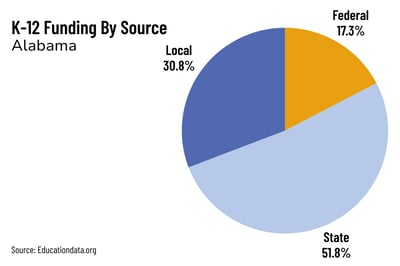
As illustrated in the chart above, the majority of K-12 funding in Alabama comes from state and local sources, rather than federal dollars.
This pattern is replicated across the country, with the average amount provided by the U.S. government per state equating to 13.6%, according to FY24 financials. There is also consensus within the education sector that K-12 school funding falls short of global benchmarks, although it is worth noting that the needs and requirements of school districts can vary dramatically from state to state.
Based on the most recent data available, total K-12 funding statewide equals approximately $10.7 billion per year, or $14,190 per pupil. The gap between funding and actual spending is roughly $548.2 million, or $730 per student.
From a taxpayer perspective, Alabama schools rely significantly more on state and local contributions (3.18% of taxpayer income) compared to federal sources (0.67%). Nationally, Alabama ranks 39th in K-12 funding and 41st in K-12 spending.
How Funding Works in Alabama
Alabama’s K-12 funding model has long relied on a structured combination of state and local revenue sources, with federal dollars supplementing districts where local capacity is limited.
At the center of this system is the Alabama State Department of Education, which distributes education funding derived from:
- State income tax revenue
- Sales tax revenue
- Corporate income tax
- Miscellaneous state and local sources
Local contributions can include property tax revenue and other community-based funding mechanisms. The balance between state and local funding varies significantly across districts.
The Foundation Program: Alabama’s Core Funding Formula
Alabama allocates the majority of K-12 funding through the Foundation Program, a resource-based formula in place since 1995.
The formula determines district allocations based on:
- Student enrollment
- Teacher salary schedules
- Local property tax valuations
- Minimum staffing requirements
The Foundation Program ensures each district can fund a baseline number of certified and ancillary personnel including principals, assistant principals, librarians, and school counselors based on student population.
To promote equity, the state share increases in districts with lower property wealth and decreases in districts with higher local revenue capacity. Property values within district boundaries are a key determinant of this calculation.
Other Current Expenses (OCE)
In addition to personnel allocations, Alabama funds Other Current Expenses (OCE)—state support for non-certified staff and operational costs.
OCE funding supports:
- Custodians
- Cafeteria workers
- Teacher aides
- Utilities
- Operations and maintenance
This structure reflects Alabama’s longstanding resource-based funding model, where dollars are tied to staffing and operational categories rather than unrestricted per-pupil allocations.
Variation Across Districts
Funding levels vary widely across the state. In districts such as Marshall County, federal funding represents a larger share of total education revenue due to lower local property tax capacity. In more affluent districts, local dollars may comprise the majority of funding.
Historically, Alabama’s per-pupil spending has trailed the national average. That gap reflects structural funding design, statutory requirements, and limits on local revenue generation rather than a singular budgetary decision.
The Education Trust Fund and RAISE
The Alabama State Senate recently passed legislation supporting a $10 billion Education Trust Fund (ETF), one of the largest investments in the state’s education system to date.
A key component of this investment is the Renewing Alabama’s Investment in Student Excellence (RAISE) Fund, which introduces weighted funding criteria to allocate additional resources to districts based on specific student needs.
While districts retain discretion over how these funds are applied locally, the long-term effects of the RAISE model will emerge gradually as implementation stabilizes.
A Funding Model in Transition
Alabama lawmakers have signaled openness to modernizing the Foundation Program framework to better align with contemporary educational and operational realities.
District leaders now operate with dual fiscal considerations:
- Immediate budget requirements
- Potential mid-year supplemental appropriations
Supplemental funding is not guaranteed, which requires districts to maintain disciplined forecasting and contingency planning. At the same time, there is broad acknowledgment that longstanding educational disparities require sustained financial attention.
Strategic Implications for District Leaders
For Alabama districts planning for FY26 and beyond, effective financial governance requires:
- Close monitoring of ETF and RAISE implementation guidance
- Alignment of staffing models with Foundation Program parameters
- Scenario planning around supplemental appropriations
- Active pursuit of federal and competitive grant opportunities
- Long-term facilities and operational cost forecasting
Alabama’s K-12 funding trajectory reflects incremental reform within a traditional structure. While the model continues to evolve, disciplined planning and proactive grant strategy remain central to district stability and growth.
Where School Safety Fits In
The expiration of ESSER funding has intensified pressure on districts to sustain digital infrastructure and school safety initiatives without federal relief dollars.
According to the recent SETDA 2025 State EdTech Trends Report:
- Funding is the single largest unmet need for school districts
- Only 6% of districts plan to sustain initiatives previously supported by ESSER (down from 27%)
- Top technology priorities for the coming school year include:
- Artificial Intelligence (17%)
- Cybersecurity (16%)
- Broadband (16%)
Source: SETDA 2025 State EdTech Trends Report
As a result, school safety now intersects directly with operational, instructional, and workforce planning priorities, making grants and alternative funding sources increasingly strategic for Alabama districts planning for FY26 and beyond.
Grant Finder: Federal Opportunities
Below is a curated list of federal programs likely to be relevant for Alabama districts entering FY26.
Application windows vary and the majority of FY26 deadlines are not yet announced at time of writing. However, a good rule of thumb is to look at the posting or closing dates for each of these federal grants and plan the application accordingly.
As we noted above, the current administration has recently signed legislation that provides the Education Department with agreed funding into law, so it is reasonable to assume that existing grant programs will be both under review and subject to an application timeline.
DOJ STOP Grant
- Due Date: Currently closed, will reopen in 2026
- Eligibility: Public, private, and charter K-12 schools
- Grant Website: https://bja.ojp.gov/funding/opportunities/o-bja-2025-172466
- Description: Provides funding to prevent and reduce school violence by implementing training, developing school threat assessment teams and/or intervention teams to identify violence risks, introducing technologies like anonymous reporting tools, or applying other school safety strategies that assist in preventing violence. The goal is to equip K–12 students, teachers, and staff with tools to recognize, respond to, and prevent acts of violence.
COPS SVPP Grant
- Due Date: Currently closed, will open again in 2026
- Eligibility: School districts (including public charter schools and school districts with a single school), school boards, law enforcement
- Grant Website: School Violence Prevention Program (SVPP) | COPS OFFICE
- Description: Provides up to 75% in funding for a variety of school safety measures in and around K-12 schools and grounds, including:
- Coordination with law enforcement
- Training for local law enforcement officers to prevent student violence against others and self
- Metal detectors, locks, lighting, and other deterrent measures
- Technology for expedited notification of local law enforcement during an emergency, or any other measures that the COPS Office determines may provide a significant improvement in security
Homeland Security Grant Program (HSGP)
- Due Date: Eligible Applicants are advised to contact their State Administration Agency (SAA) if interested in grant funding
- Eligibility: State, local, tribal, and territorial governments, as well as nonprofits (subrecipients)
- Grant Website: https://www.fema.gov/grants/preparedness/homeland-security
- Description: Allowable expenses include materials to conduct planning, engagement, and volunteer management activities; interoperable communications equipment; measures to increase physical security; training conferences; and more.
State HSGP
- Due Date: Contact SAA for application dates and eligibility requirements
- Eligibility: Local law enforcement, as well as nonprofits (subrecipients)
- Grant Website: State Administrative Agency (SAA) Contacts | FEMA.gov
- Description: Administered by FEMA, the SHSP is part of the broader Homeland Security Grant Program (HSGP). It provides funding to state, local, tribal, and territorial governments to enhance their ability to prevent, protect against, respond to, and recover from terrorist attacks and other emergencies. You must apply through your State Administrative Agency (SAA) and cannot apply directly to FEMA. Not all states permit schools to apply, so check with your SAA for more details. Funds are allocated based on risk assessments and the effectiveness of proposed initiatives.
- Key focus areas: Planning, Equipment Acquisition, Training and Exercises
Nonprofit Security Grant Program (NSGP)
- Due Date: Contact the Alabama Office of the Governor, Homeland Security Grants Division
- Eligibility: Nonprofit 501(c)(3) organizations (subrecipients)
- Grant Website: https://www.fema.gov/grants/preparedness/nonprofit-security
- Description: Allowable expenses include identification, assessment, and reporting of threats of violence; improving cybersecurity of access control, identity verification systems, and security technologies; security training for employees; and more.
Stronger Connections Grant Program
- Due Date: Not Applicable
- Eligibility: State Educational Agencies
- Grant Website: Stronger Connections Grant (SCG) | U.S. Department of Education
- Description: A core component of the 2022 Bipartisan Safer Communities Act, the SCGP provides funding for local communities and leaders to improve schools’ climate and student achievement. The program awards funds to local education authorities that integrate evidence-based approaches to safe, supportive, and healthy schools. These can include security measures, wellness initiatives, safety planning and associated school safety training.
At the time of writing, it should be noted that FY26 application deadlines for a number of federal grants that specifically fund school safety programs can either vary or have not been announced.
If that is still the case, then school administrators should ensure that they sign up for programs that are of interest at SchoolSafety.gov to ensure that they receive updates on new school safety-related grant opportunities when the window opens again for FY26.
In addition, there is an official website designed to simplify the federal grant application and eligibility process – Grants.gov – which is filled with resources and helpful tips. This website is flagged up on the NSGP webpage, although it has dated content and deadline dates that are either passed or TBD.
State & Non-Federal Funding Pathways
State spending is projected to increase in FY26 - FY27. However, the level of funding available is (at time of writing) still under discussion with media sources reporting that legislators are budgeting for a minimum of $5.6 billion in FY27 – that is an increase of $347 million from the agreed FY26 budget.
This number is heavily dependent on student enrollment data, albeit that these numbers have dropped in recent years. On the flip side, a spending cap put in place by lawmakers in 2023 has changed how educators and school admins approach the budgeting process.
In recent years, the state has benefited from strong tax collection policies. This has created a recurring surplus, some of which has been directed into supplemental appropriation. Between 2021 and 2025, for example, lawmakers allocated almost $7 billion in surplus tax revenue from the ETF, most of which was deposited into savings accounts.
School safety-focused grants are constantly under discussion at the state level, but the Department of Education does encourage residents to submit a Request for Proposal during the school year. These include questions and responses that align with critical school safety tools such as emergency response, panic buttons, mass notification systems, access control, video surveillance and more. You can search the RFP database through this link.
The Alabama K-12 Capital Grant Program is one avenue that school admins can take. The program will allocate eligible entities up to $5 million per grant for capital projects that:
- Improve school safety and security
- Provide technology and equipment for schools to enhance the educational environment
- Defer the total cost of maintenance for existing facilities
It is also worth noting that Alabama is one of several states that is currently considering the implementation of Alyssa’s Law in its K-12 schools. You can read our latest blog on the state of play for the integration of panic button systems in every U.S. school here.
The legislation in Alabama is (like many other states) deemed to be pending, although there have been limited attempts to get this passed since it was first drafted in 2024. The Board of Education is currently considering a second version, introduced in February 2025 after the initial bill was rejected in committee.
Foundation & Private Sector Opportunities
Districts may also access safety-aligned funds through mission-driven organizations, including:
Subscription search engines (GrantWatch, GrantPortal) offer additional visibility, though often behind paywalls. The CDW Education Funding webpage is also a good resource for state-specific grant programs, although it also requires the end user to login via its email provider to access the full database of resources and K-12 funding opportunities.
Applying Strategically
Grants are competitive and time-bounded. The strongest applications connect:
- Mission → Solution → Measurable Benefit → Implementation Readiness
Kokomo24/7® supports districts in mapping funding opportunities to student safety and operational goals. Our team assists with identification, strategy alignment, and application support.
The Outlook for FY26 and Beyond
In light of recent positive developments (from a funding standpoint, crucially) at the U.S. Department of Education, it is clear that the FY26 landscape is not defined by lack of funds. Rather, it continues to be beholden to complexity and an increased level of uncertainty as to how the federal funding process will both evolve and its impact on long-standing funding channels.
With that in mind, school districts and K-12 administrators willing to diversify funding streams, anticipate federal shifts, and accelerate grant strategies will be better positioned to support safety, innovation, and student outcomes in not only the year ahead but also FY27 and beyond. Funding for K-12 schools is a constant conversation, what matters is having the right partner at the right time to steer you down the right path.
About Kokomo24/7®
Kokomo Solutions, Inc. (Kokomo24/7®) is an enterprise B2B software company founded and based in Chicago, IL featuring a flexible software platform with proven solutions around health, safety, and operational use cases serving over 100 enterprise clients, including many education institutions, corporations, and municipalities.
Kokomo24/7® offers schools and workplaces a holistic platform for health, safety, and operational efficiency. Most organizations are inundated with fragmented solutions and struggle to provide streamlined services. Adopt a platform that can grow with you.
Request a demo to see the flexibility of the Kokomo24/7® platform for yourself!

 CASES™
 ESCALATE™
 TRIAGE™
 NOTIFY™
 FORMS™
 ANALYTICS™
 HOST™
HOST™ OWLPASS®
 ACCESS™
 WELLNESS™
 CREDENTIALS™