FY26 K–12 Funding: Uncertainty Is the New Normal
Complexity has long been the status quo for K- 12 school administrators navigating funding cycles. In FY26, that complexity has evolved into something more challenging: securing reliable funding in an environment where uncertainty itself has become standard operating procedure.
K–12 funding remains a mosaic of federal, state, and local dollars. Eligibility rules, compliance obligations, and application timelines are familiar constraints for seasoned administrators. What has changed is the core question districts are asking. It is no longer simply “where is the money” it is “when it will arrive” and “under what conditions”.
Federal Uncertainty: A Moving Target
Recent policy actions have added new layers of ambiguity to the federal funding ecosystem. Questions around what resources may be allocated to student-facing programs, infrastructure investments, and long-standing grant programs have made unpredictability a defining feature of FY26 planning.
At the same time, ongoing national discussions about the future role and structure of the U.S. Department of Education and which agencies may assume responsibility for its functions have created unnecessary funding-related friction for districts already operating under tight margins.
In a recent K-12 Dive op-ed, Denise Forte, President and CEO of EdTrust, noted that state leaders are confronting confusion on multiple fronts, from shifting federal priorities to inconsistent reporting and accountability structures.
Forte pointed to a striking example in Florida, where state officials were unable to determine where 30,000 students were enrolled or how $270 million in voucher funds were being used. When paired with proposed Department of Education restructuring, this has pushed federal support into what many educators now describe as a “gray zone.”
Data Points
- $6.2B in federal K-12 funding for FY25 was temporarily withheld in July 2025
- Represented approximately 14.4% of the prior-year DOE budget
- Resulted in delayed staffing, programming, and long-term planning decisions across districts
Infrastructure Pressure Beneath the Surface
According to the State of Our Schools 2025 report, K-12 education is now second only to highways in terms of capital outlay for public infrastructure nationwide.
Much of this spending is financed through long-term debt and repaid annually through district education budgets. State and federal support is described in the report as “varied, unstable, and inadequate.”
In many cases, federal funding for major infrastructure improvements follows crises or natural disasters rather than proactive investment. FEMA alone awarded nearly $13 billion in grants to school districts between FY13 and FY23. While significant, this figure represents only a portion of the broader, ongoing funding needs facing districts.
School leaders understand that buildings and grounds require continual investment, not only to remain operational, but to support a safe, supportive environment that reflects a district’s duty of care to students, staff, and the wider community.
Spending Is Rising—But So Are Expectations
Despite federal uncertainty, overall K-12 spending continues to trend upward.
Long-Term Funding Trends (2002–2023):
- 35.8% increase in public K-12 funding
- $946.5B in total funding nationwide in 2023
- Per-pupil spending increased from $14,969 to $20,322
Source: The Reason Foundation, K-12 Education Spending Spotlight
The takeaway is clear: funding growth is real but so are rising expectations. Districts are being asked to do more with more oversight, greater accountability, expanded safety responsibilities, and increasing operational costs.
Uncertainty is no longer an exception to plan around. It is the environment itself.
Grant Finder State Spotlight: Virginia
Virginia K-12 schools spend an average of $16,445 per pupil, totaling approximately $20.7 billion annually.
- Federal funding: $2.55 billion ($2,021 per pupil)
- State funding: $8.14 billion ($6,457 per pupil)
- Local funding: $10.2 billion ($8,112 per pupil)
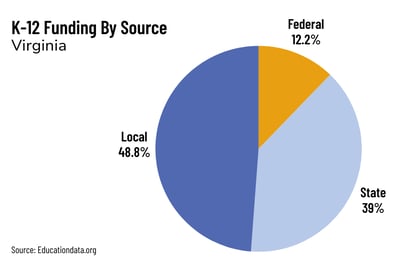
As illustrated in the chart above, the majority of K-12 funding in Virginia comes from state and local sources, rather than federal dollars.
Based on the most recent data available, total K-12 funding statewide equals approximately $20.89 billion per year, or $16,590 per pupil. The gap between funding and actual spending is roughly $183.4 million, or $146 per student.
From a taxpayer perspective, Virginia schools rely significantly more on state and local contributions (2.85% of taxpayer income) compared to federal sources (0.40%). Nationally, Virginia ranks 25th in K-12 funding and 26th in K-12 spending.
How Funding Works in Virginia
According to the Virginia Department of Education (VDOE), public schools are funded through a combination of local, state, and federal dollars, with additional funding opportunities sometimes provided through private-sector partnerships with school divisions.
At the state level, the Virginia General Assembly is responsible for distributing K–12 funding through its biennial Appropriations Act. General Fund appropriations represent the primary source of state support and are supplemented by retail sales and use taxes, Virginia Lottery proceeds, and other dedicated revenue streams.
Local governments (counties, cities, and towns) are also required to contribute their share to public education. These local contributions ensure that each school division can deliver an educational program that meets Virginia’s Standards of Quality (SOQ), which establish the minimum cost of providing a high-quality education for every student, regardless of location.
The Role of the Standards of Quality (SOQ)
The SOQ funding formula relies heavily on the Local Composite Index (LCI), a measure designed to estimate a locality’s ability to pay for education. The LCI considers factors such as:
- Real property values
- Income and sales tax capacity
- Overall local fiscal strength
This index determines how education costs are split between the state and each locality. In practice, however, the formula has drawn increasing scrutiny.
A 2023 study commissioned by the General Assembly found that many Virginia school divisions were underfunded, citing structural flaws and outdated assumptions within the SOQ formula. The study concluded that Virginia provides less K-12 funding per student than both the national and regional average, resulting in an estimated $1,900 per-student shortfall. Neighboring states, including West Virginia, Kentucky, and Maryland, spend more per pupil.
The report also noted that the SOQ formula does not sufficiently account for higher-need or at-risk students, including those living in poverty.
A Staffing-Based Model Under Pressure
Virginia is one of just nine states that use a staffing-based funding model, rather than a student-centered formula. Under this approach, funding is tied to prescribed staffing ratios rather than actual student enrollment or demonstrated need.
In FY21 alone, this model resulted in approximately $6.6 billion less in state funding than what local school divisions ultimately spent to operate their schools.
According to a recent VDOE report, all school divisions met or exceeded their required local effort in FY25. A prerequisite for calculating state funding under the SOQ formula. This compliance allows FY26 budget calculations to move forward, with updated projections expected in March 2026.
FY26 Outlook: Growing Needs, Limited Resources
Despite this progress, state officials have already acknowledged that available funding may not fully meet district needs. Lawmakers have indicated that the SOQ baseline for FY26 will be at least $844 million, based on updated enrollment and revenue projections.
At the same time, a December 2025 presentation by the Department of Education estimated that Virginia schools would require approximately $1.2 billion over the next two years to address rising costs. Enrollment trends will play a significant role in determining final allocations.
While enrollment is projected to decline modestly, districts must still account for teacher pay increases, infrastructure improvements, and ongoing program enhancements. Complicating matters further, not all school divisions had submitted daily attendance data for FY25 at the time of the December briefing. These delays could impact final funding determinations.
Where School Safety Fits In
The expiration of ESSER funding has intensified pressure on districts to sustain digital infrastructure and school safety initiatives without federal relief dollars.
According to the SETDA 2025 State EdTech Trends Report:
- Funding is the single largest unmet need for school districts
- Only 6% of districts plan to sustain initiatives previously supported by ESSER (down from 27%)
- Top technology priorities for the coming school year include:
- Artificial Intelligence (17%)
- Cybersecurity (16%)
- Broadband (16%)
Source: SETDA 2025 State EdTech Trends Report
As a result, school safety now intersects directly with operational, instructional, and workforce planning priorities, making grants and alternative funding sources increasingly strategic for Virginia districts planning for FY26 and beyond.
Grant Finder: Federal Opportunities
Below is a curated list of federal programs likely to be relevant for Virginia districts entering FY26. Application windows vary and some FY26 deadlines are not yet announced at time of writing.
DOJ STOP Grant
- Due Date: Currently closed, will reopen in 2026
- Eligibility: Public, private, and charter K-12 schools
- Grant Website: https://bja.ojp.gov/funding/opportunities/o-bja-2025-172466
- Description: Provides funding to prevent and reduce school violence by implementing training, developing school threat assessment teams and/or intervention teams to identify violence risks, introducing technologies like anonymous reporting tools, or applying other school safety strategies that assist in preventing violence. The goal is to equip K–12 students, teachers, and staff with tools to recognize, respond to, and prevent acts of violence.
COPS SVPP Grant
- Due Date: Currently closed, will open again in 2026
- Eligibility: School districts (including public charter schools and school districts with a single school), school boards, law enforcement
- Grant Website: School Violence Prevention Program (SVPP) | COPS OFFICE
- Description: Provides up to 75% in funding for a variety of school safety measures in and around K-12 schools and grounds, including:
- Coordination with law enforcement
- Training for local law enforcement officers to prevent student violence against others and self
- Metal detectors, locks, lighting, and other deterrent measures
- Technology for expedited notification of local law enforcement during an emergency, or any other measures that the COPS Office determines may provide a significant improvement in security
Homeland Security Grant Program (HSGP)
- Due Date: Application window is currently closed
- Eligibility: State, local, tribal, and territorial governments, as well as nonprofits (subrecipients)
- Grant Website: https://www.fema.gov/grants/preparedness/homeland-security
- Description: Allowable expenses include materials to conduct planning, engagement, and volunteer management activities; interoperable communications equipment; measures to increase physical security; training conferences; and more.
State HSGP
- Due Date: Contact state administration agency for application dates
- Eligibility: Local law enforcement, as well as nonprofits (subrecipients)
- Grant Website: State Administrative Agency (SAA) Contacts | FEMA.gov
- Description: Administered by FEMA, the SHSP is part of the broader Homeland Security Grant Program (HSGP). It provides funding to state, local, tribal, and territorial governments to enhance their ability to prevent, protect against, respond to, and recover from terrorist attacks and other emergencies. You must apply through your State Administrative Agency (SAA) and cannot apply directly to FEMA. Not all states permit schools to apply, so check with your SAA for more details. Funds are allocated based on risk assessments and the effectiveness of proposed initiatives.
- Key focus areas: Planning, Equipment Acquisition, Training and Exercises
Nonprofit Security Grant Program (NSGP)
- Due Date: Contact the Ohio Office of the Governor, Homeland Security Grants Division
- Eligibility: Nonprofit 501(c)(3) organizations (subrecipients)
- Grant Website: https://www.fema.gov/grants/preparedness/nonprofit-security
- Description: Allowable expenses include identification, assessment, and reporting of threats of violence; improving cybersecurity of access control, identity verification systems, and security technologies; security training for employees; and more.
Stronger Connections Grant Program
- Due Date: Not Applicable
- Eligibility: State Educational Agencies
- Grant Website: Stronger Connections Grant (SCG) | U.S. Department of Education
- Description: A core component of the 2022 Bipartisan Safer Communities Act, the SCGP provides funding for local communities and leaders to improve schools’ climate and student achievement. The program awards funds to local education authorities that integrate evidence-based approaches to safe, supportive, and healthy schools. These can include security measures, wellness initiatives, safety planning and associated school safety training.
At the time of writing, it should be noted that FY26 application deadlines for a number of federal grants that specifically fund school safety programs can either vary or have not been announced.
If that is still the case, then school administrators should ensure that they sign up for programs that are of interest at SchoolSafety.gov to ensure that they receive updates on new school safety-related grant opportunities when the window opens again for FY26.
State & Non-Federal Funding Pathways
Virginia spending is projected to increase in FY26 - FY27. However, the level of funding available is (at time of writing) still under discussion with media sources reporting that state schools will need at least $1.2 billion over the next two years.
This number is heavily dependent on enrollment data, with lawmakers noting that these numbers have dropped in recent years. On the flip side, there is a consensus within the VDOE that continued investments in areas that impact educational quality is a crucial part of its remit. School employee benefits and upgrades to existing K-12 safety protocols are, media sources said, likely to become more of a priority when the final budget is agreed.
School safety-focused grants include:
- School Safety and Security Grant
- Awarded annually, VDOE allocates base funding of $50,000 per school division
- Expenditures must be reported during the applicable school year to ensure that all relevant funding (state and federal) is obligated by December of that year. For example, any expenditure related to school safety that applied to FY2025 must be obligated by 31 December 2025.
- Security Equipment Grants
- Provides $12 million to K-12 schools for improving and maintaining student safety
- Reimbursable expenses include mass notification systems, software to support upgrades to security systems, visitor ID badging, panic buttons and more
- School divisions are eligible to receive up to $250,000 each fiscal year through a competitive grant process
- Applications are submitted to the VDOE, with the window running from 1st July to the 1st August
- Digital Mapping Program for K-12 Schools
- Funding available to school divisions for Digital Mapping initiatives, up to a maximum of $3,500 (multiplied by the number of schools in that division that are mapped
- Applications are approved on a rolling basis and subject to approved vendors
It is also worth noting that Virginia is one of several states that is currently considering the implementation of Alyssa’s Law in its K-12 schools. You can read our latest blog on the state of play for the integration of panic button systems in every U.S, school here.
The legislation in Virginia is deemed to be pending, although there have been several attempts to get this passed since it was first introduced in 2022. The bill currently has a delayed effective date for discussion of July 1, 2026.
Foundation & Private Sector Opportunities
Districts may also access safety-aligned funds through mission-driven organizations, including:
Subscription search engines (GrantWatch, GrantPortal) offer additional visibility, though often behind paywalls.
Applying Strategically
Grants are competitive and time-bounded. The strongest applications connect:
- Mission → Solution → Measurable Benefit → Implementation Readiness
Kokomo24/7® supports districts in mapping funding opportunities to student safety and operational goals. Our team assists with identification, strategy alignment, and application support.
The Outlook for FY26
The FY26 landscape is not defined by lack of funds, it is defined by complexity and an increased level of uncertainly as to what the federal funding process will eventually look like. Districts willing to diversify funding streams, anticipate federal shifts, and accelerate grant strategies will be better positioned to support safety, innovation, and student outcomes in the year ahead.
About Kokomo24/7®
Kokomo Solutions, Inc. (Kokomo24/7®) is an enterprise B2B software company founded and based in Chicago, IL featuring a flexible software platform with proven solutions around health, safety, and operational use cases serving over 100 enterprise clients, including many education institutions, corporations, and municipalities.
Kokomo24/7® offers schools and workplaces a holistic platform for health, safety, and operational efficiency. Most organizations are inundated with fragmented solutions and struggle to provide streamlined services. Adopt a platform that can grow with you.
Request a demo to see the flexibility of the Kokomo24/7® platform for yourself!

 CASES™
 ESCALATE™
 TRIAGE™
 NOTIFY™
 FORMS™
 ANALYTICS™
 HOST™
HOST™ OWLPASS®
 ACCESS™
 WELLNESS™
 CREDENTIALS™