K-12 school funding for FY26 remains top-of-mind for administrators nationwide. The familiar patchwork of federal, state, and local funding sources continues to raise questions. Not only about how much funding will be available, but when it will arrive and how districts can access it.
School leaders understand that each funding stream comes with its own eligibility requirements, compliance rules, and application timelines. Yet knowing where to apply is only part of the equation. Increasing uncertainty at the federal level has added a new layer of complexity to already constrained budget planning.
Decisions by the current administration affecting the U.S. Department of Education—including proposed budget changes and the transfer of administrative functions to the Department of Labor—have introduced what many educators view as a gray area in the federal K-12 funding ecosystem. As a result, there is growing consensus across the education sector that the next 12 months may present heightened funding challenges for school districts nationwide.
Earlier this year, for example, $6.2 billion in federal K-12 funding approved by Congress for FY25 was temporarily withheld, representing approximately 14.4 percent of the Department of Education’s prior-year budget. That delay left many districts in a state of financial limbo, complicating staffing, programming, and long-term planning decisions.
At the same time, overall education spending continues to rise. A recent study by the Reason Foundation found that public K-12 funding increased by 35.8 percent between 2002 and 2023. K-12 Dive reported that public schools nationwide received $946.5 billion in total funding in 2023, with average per-student spending increasing from $14,969 to $20,322 over the same period. The takeaway is clear: while funding levels have grown, so too have expectations, costs, and state-level obligations.
With that context in mind—and as part of our ongoing Grant Finder blog series—below is an overview of current federal, state, and alternative funding sources available to Wisconsin K-12 schools.
The Basics: K-12 Funding in Wisconsin
Wisconsin K-12 schools spend an average of $16,744 per pupil, totaling approximately $13.8 billion annually.
- Federal funding: $1.63 billion ($1,711 per pupil)
- State funding: $7.39 billion ($8,973 per pupil)
- Local funding: $5.13 billion ($6,234 per pupil)
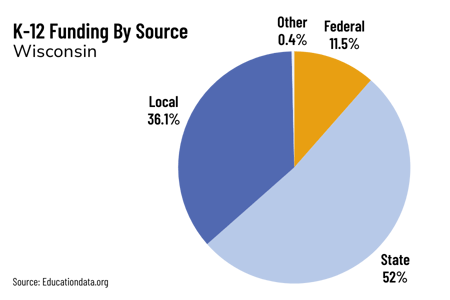
As illustrated in the chart above, the majority of K-12 funding in Wisconsin comes from state and local sources, rather than federal dollars.
Based on the most recent data available, total K-12 funding statewide equals approximately $14.2 billion per year, or $17,193 per pupil. The gap between funding and actual spending is roughly $370.1 million, or $450 per student.
From a taxpayer perspective, Wisconsin schools rely significantly more on state and local contributions (3.26 percent of taxpayer income) compared to federal sources (0.43 percent). Nationally, Wisconsin ranks 22nd in both K-12 funding and spending.
Federal vs. Non-Federal Funding
Federal funding supports a wide range of district needs, including academic programs, infrastructure, technology, and student services. However, the amount of federal funding a district receives can vary significantly. Some districts receive little to no federal support, while others may fund up to 75 percent of their operating expenses through federal programs.
Eligibility is often influenced by factors such as poverty levels, student demographics, population density, and the availability of state and local revenue. Recent federal policy shifts—including the proposed reorganization of Department of Education programs—have raised concerns that administrative changes could create funding delays or barriers in FY26 and beyond.
By contrast, non-federal funding is generated primarily through state and local tax revenue, including property, sales, and income taxes. These funds are distributed using formulas that consider enrollment, district wealth, and prior-year spending.
Wisconsin is somewhat unique in this regard. Unlike most states that rely on student-based, resource-based, or hybrid funding models, Wisconsin uses a formula administered by the Department of Public Instruction (DPI). Only Vermont follows a similar approach.
While this makes Wisconsin an outlier, the intent remains consistent: to ensure that all students have access to a basic educational opportunity regardless of local fiscal capacity. DPI’s Equalization Aid formula is specifically designed to reduce reliance on property taxes and promote statewide funding equity.
Grant Finder
Funding can be uncertain, and many administrators say that they don't have the resources available to accomplish everything they want to do. This becomes even more of a challenge when funding for school safety programs and related initiatives is factored into any ongoing financial optimization or budgeting strategy.
EdTech Magazine recently reported that funding is the biggest unmet need by school districts across the country, with the expiration of the Elementary and Secondary School Emergency Relief Fund (ESSER) cited as a key concern going forward. According to the SETDA 2025 State EdTech Trends Report, only 6 percent of respondents said they would continue with any initiatives that were previously supported by ESSER, a drop from 27 percent in 2024.
The report also noted that state-funded support for technology such as high-speed internet access through broadband is slowing down, with school districts increasingly forced to advocate for themselves to get the digital resources they need.
Grants are obviously a funding source that can drive transformative impact for administrators, educators, and students. At the same time, grants can be difficult to identify and time-consuming to complete. Additionally, the window for applications has a finite lifespan, which often makes the need to get supporting documents to the relevant funding source a race against time.
Here is a curated list of grants that Wisconsin K-12 schools can use to fund district needs. Please note that this list is accurate at time of writing and can be used as a guide for what should be available FY26.
DOJ STOP Grant
- Due Date: Currently closed, will reopen in 2026
- Eligibility: Public, private, and charter K-12 schools
- Grant Website: https://bja.ojp.gov/funding/opportunities/o-bja-2025-172466
- Description: Provides funding to prevent and reduce school violence by implementing training, developing school threat assessment teams and/or intervention teams to identify violence risks, introducing technologies like anonymous reporting tools, or applying other school safety strategies that assist in preventing violence. The goal is to equip K–12 students, teachers, and staff with tools to recognize, respond to, and prevent acts of violence.
COPS SVPP Grant
- Due Date: Currently closed, will open again in 2026
- Eligibility: School districts (including public charter schools and school districts with a single school), school boards, law enforcement
- Grant Website: School Violence Prevention Program (SVPP) | COPS OFFICE
- Description: Provides up to 75% in funding for a variety of school safety measures in and around K-12 schools and grounds, including:
- Coordination with law enforcement
- Training for local law enforcement officers to prevent student violence against others and self
- Metal detectors, locks, lighting, and other deterrent measures
- Technology for expedited notification of local law enforcement during an emergency, or any other measures that the COPS Office determines may provide a significant improvement in security
Homeland Security Grant Program (HSGP)
- Due Date: Application window is currently closed
- Eligibility: State, local, tribal, and territorial governments, as well as nonprofits (subrecipients)
- Grant Website: https://www.fema.gov/grants/preparedness/homeland-security
- Description: Allowable expenses include materials to conduct planning, engagement, and volunteer management activities; interoperable communications equipment; measures to increase physical security; training conferences; and more
State HSGP
- Due Date: Contact state administration agency for application dates
- Eligibility: Local law enforcement, as well as non-profits (sub-recipients)
- Grant Website: State Administrative Agency (SAA) Contacts | FEMA.gov
- Description: Administered by FEMA, the SHSP is part of the broader Homeland Security Grant Program (HSGP). It provides funding to state, local, tribal, and territorial governments to enhance their ability to prevent, protect against, respond to, and recover from terrorist attacks and other emergencies. You must apply through your State Administrative Agency (SAA) and cannot apply directly to FEMA. Not all states permit schools to apply, so check with your SAA for more details. Funds are allocated based on risk assessments and the effectiveness of proposed initiatives.
- Key focus areas: Planning, Equipment Acquisition, Training and Exercises
Nonprofit Security Grant Program (NSGP)
- Due Date: Contact the Wisconsin Office of the Governor, Homeland Security Grants Division
- Eligibility: Nonprofit 501(c)(3) organizations (subrecipients)
- Grant Website: https://www.fema.gov/grants/preparedness/nonprofit-security
- Description: Allowable expenses include identification, assessment, and reporting of threats of violence; improving cybersecurity of access control, identity verification systems, and security technologies; security training for employees; and more.
Stronger Connections Grant Program
- Due Date: Not Applicable
- Eligibility: State Educational Agencies
- Grant Website: Stronger Connections Grant (SCG) | U.S. Department of Education
- Description: A core component of the 2022 Bipartisan Safer Communities Act, the SCGP provides funding for local communities and leaders to improve schools’ climate and student achievement. The program awards funds to local education authorities that integrate evidence-based approaches to safe, supportive and healthy schools. These can include security measures, wellness initiatives, safety planning and associated school safety training.
At the time of writing, it should be noted that application deadlines for a number of federal grants that specifically fund school safety programs can vary and the window is likely to be closed for FY25.
If that is the case, then school administrators should ensure that they sign up for programs that are of interest at SchoolSafety.gov to ensure that they receive updates on new school safety-related grant opportunities when the window opens again for FY26.
However, the Wisconsin Office of School Safety is currently accepting FY26 School Access for Emergency Response (SAFER) grants – you can access this announcement here – and Enhance School Incident Response (ESSIR) grants (link)
Federal funding in Wisconsin can also to be subject to what is known as braiding or blending. Simply put, this is a process of combining funding sources or educational grants to maintain or support different aspects or levels of funding, This requires LEAs to understand the allowable uses of each funding source and the federal regulations or guidelines that apply.
Non-Federal or Other State Resources
If you are looking to apply for grants from non-federal/state resources or foundations, the process can seem daunting.
Wisconsin (as is the case for other states in this series) has various online grant-specific resources that school administrators use to nail down financial assistance based on their specific needs.
School safety, for example, is a key part of the state’s funding avenues, with the Wisconsin Department of Justice providing grants for a range of School Safety Grants that cover:
- Digital Mapping of School Buildings
- Critical Incident Stabilization
- Student Safety Training
Full details of the Wisconsin DOJ-sponsored grant program can be found here, including how to apply for funding, who is eligible and details of past awards/awardees and the amounts they received for school safety improvements.
The online availability of various grant and funding search engines (GrantWatch, TheGrantPortal, to name two) is another resource for K-12 school administrators. These keyword-heavy options can guide the school towards funding streams that will consider applications on a case-by-case basis. The caveat is that these resources often require the applicant to become a paid subscriber to access the features and keyword search functionality.
If this paid search option is not appealing, there are organizations that are dedicated to school safety programs or community initiatives, and who don’t live behind gated content. These additional resources include, but are not limited to:
School administrators should note that funding, for the most part, is more likely to be geared towards education and providing financial support for low-income or at-risk students and families.
However, there are grants available for various unspecified programs, details of which can be accessed via the CDW Education Funding website, but these are also subject to required deadlines and vary from state to state in both what they will fund and eligibility. However, a newly created state grant program that is now open for applications is another path that school administrators in Wisconsin can take.
According to Wisconsin Public Radio, $10 million in financial aid is available for violence prevention work, with the program accepting applications for grants that can be used to fund violence (including gun) prevention projects statewide.
Five distinct categories are available, including:
- Suicide prevention and firearm storage grants
- Evidence-based violence intervention and outreach programs
- Criminal justice-based initiatives
- Domestic violence prevention initiatives
- School-based programming
Full details of the State Violence Prevention Grant Program and its application process can be found here, but the underlying theme of the initiative is, the news source said, to “focus on interrupting violence, preventing suicide, and reducing harm.”
Applications for the program must be submitted by January 16, and allowable expenses or initiatives include training, behavioral threat assessment, conflict resolution, onsite violence prevention, and more.
Applying for Grants
After identifying a potential funding source, preparing a strong application is important. Kokomo24/7® can work with your school district to assist and strengthen your application.
As a leader in school safety, our team is deeply experienced at mapping funding options to the solutions you need. We are happy to provide advice and support whenever you need it from our experts.
Request time with Kokomo24/7® to assist and strengthen your grant application!
About Kokomo24/7®
Kokomo Solutions, Inc. (Kokomo24/7®) is an enterprise B2B software company founded and based in Chicago, IL featuring a flexible software platform with proven solutions around health, safety, and operational use cases serving over 100 enterprise clients, including many education institutions, corporations, and municipalities.
Kokomo24/7® utilizes a unique flexible architecture, Kokomo GPA, that differentiates itself from all other point-solutions offered by its competitors. Kokomo24/7® offers organizations the ability to quickly create niche solutions and utilize its current bundle of highly configurable modules. Kokomo24/7® easily pairs with external services, data sources, and hardware devices to create a seamless interaction with clients’ existing systems.
Request a demo to see the flexibility of the Kokomo24/7® platform for yourself!

 CASES™
 ESCALATE™
 TRIAGE™
 NOTIFY™
 FORMS™
 ANALYTICS™
 HOST™
HOST™ OWLPASS®
 ACCESS™
 WELLNESS™
 CREDENTIALS™