"A couple of other software providers I looked at didn’t have the same functionality...I always felt like I got an answer and somebody to walk me through it and to get back to me quickly, which I really appreciated."
FY26 K–12 Funding: Uncertainty as a Structural Reality
As the current school year ends, complexity remains central to how K-12 funding is planned, managed, and executed. For districts preparing for FY26 and beyond, that complexity now operates as a structural condition, defined by shifting timelines, evolving eligibility requirements, and administrative rules that can change mid-year.
District leaders are navigating an environment where familiar questions persist, but the answers are less predictable. Funding decisions still begin with the same core considerations:
When will funds be released?
What conditions will govern their use?
How stable are allocations across fiscal years?
A recent report found that 42 states allocated a smaller share of their budgets to K-12 education in FY22-23 than they did two decades earlier. The implication is clear: identifying and securing diversified funding streams has become a foundational component of district strategy.
Federal Funding: Variable and Under Review
K-12 funding continues to rely on a layered mix of federal, state, and local dollars. While district administrators are experienced in navigating compliance requirements, formula grants, and reporting obligations, federal funding introduces a level of variability that complicates long-term planning.
Federal dollars represent a relatively small portion of total K-12 funding nationwide. Recent legislation allocates $79 billion to the U.S. Department of Education through September, including a modest increase over FY25 projections. At the same time, ongoing discussions around reallocating federal education responsibilities to other agencies and the potential restructuring of the Department itself continue to create uncertainty.
Even incremental governance changes can affect reporting requirements, compliance expectations, and the timing of funding allocations. Operational shifts within the Department have added further complexity, particularly in areas tied to data collection on student outcomes, workforce trends, and school performance. Workforce reductions have raised concerns about the long-term reliability of federal datasets used for planning and policy decisions.
Recent federal budget proposals have introduced additional considerations, including proposed reductions in Department of Education funding and the elimination of select K-12 programs. While similar proposals have previously been modified or rejected by Congress, the direction of federal policy remains an active variable for district planning.
Contextual Risk Signals
Recent events illustrate how quickly funding conditions can change:
$6.2 billion in federal K–12 funding for FY25 was temporarily withheld in July 2025
This represented approximately 14.4% of the prior-year Department of Education budget
Districts were forced to delay staffing decisions, adjust program timelines, and revisit multi-year plans
Legal challenges are also shaping the funding landscape. Lawsuits in Wisconsin, Kentucky, New Hampshire, and Wyoming have focused on funding adequacy and the responsiveness of state formulas to inflation and student need.
At a national level, disparities remain significant. Research indicates that two-thirds of students in chronically underfunded states are concentrated in just ten states. The Albert Shanker Institute estimates that K-12 schools lost nearly $600 billion in state and local funding between 2016 and 2023, widening gaps between districts with varying levels of local wealth.
The State of Our Schools 2025 report ranks K-12 education second only to highways in total public infrastructure spending. Much of this investment is financed through long-term debt, repaid through district operating budgets.
Federal disaster relief provides support, but it remains reactive. Between FY13 and FY23, Federal Emergency Management Agency (FEMA) awarded nearly $13 billion to school districts, funding that addresses only a portion of long-term needs.
Districts continue to manage ongoing capital demands, including:
Facilities modernization
HVAC replacement
Safety and security upgrades
Technology infrastructure expansion
Compliance-driven renovations
At the same time, evolving federal priorities and funding constraints have introduced additional delays and uncertainty in infrastructure-related grant programs.
Spending Growth and Expanded Expectations
Despite volatility, overall K-12 spending continues to rise:
Long-Term Funding Trends (2002–2023)
35.8% increase in public K-12 funding
$946.5 billion in total nationwide spending (2023)
Per-pupil funding increased from $14,969 to $20,322
(Source: Reason Foundation)
Spending growth has coincided with expanded expectations across multiple domains:
Campus safety and security
Mental health and student support services
Cybersecurity and technology modernization
Compliance and reporting requirements
Many funding streams remain restricted or program-specific, limiting discretionary flexibility.
Mental health services provide a clear example. Data from the American School Counselor Association indicates a national student-to-counselor ratio of 372:1, underscoring the need to expand access to support services for hundreds of thousands of students. These services are increasingly integrated into broader school safety and threat assessment frameworks.
Planning in a Persistent State of Flux
Volatility in K-12 funding has shifted from episodic disruption to a continuous operating condition.
Districts preparing for FY26 are prioritizing:
Diversified funding strategies
Scenario-based budgeting
Early grant identification and planning
Multi-year forecasting that incorporates timing risk
Alignment between funding eligibility and operational priorities
Districts that embed uncertainty into their planning assumptions are better positioned to absorb policy shifts, delays, and allocation changes.
Grant Finder State Spotlight: New Jersey
New Jersey provides a clear example of how funding structures can differ from national averages.
According to recent financial data:
Total school aid: approximately $12.1 billion (FY25)
Per-pupil spending: approximately $26,280
Total expenditure (including capital): approximately $27,683
Total public funding per pupil: approximately $28,364
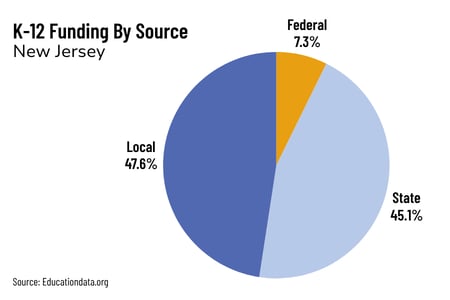
Funding Breakdown:
Federal: 7.28% ($2,066 per pupil)
State: 45.13% ($12,802 per pupil)
Local: 47.58% ($13,495 per pupil)
Compared to the national average of 13.6% federal funding, New Jersey relies heavily on state and local revenue. This structure contributes to its ranking as one of the top-funded states in the country.
How K-12 Funding Works in New Jersey
Public education funding in New Jersey is governed by the School Funding Reform Act (SFRA) of 2008, which is designed to ensure a “thorough and efficient” education for all students.
The model is based on a weighted student formula with four key components:
Base cost: a standard per pupil amount determined by K-12 grade level (elementary, middle, and high school)
Weights for Need:extra funding is added for ‘at-risk’ students (low-income), multilingual learners, and students with disabilities
Local Fair Share (LFS): what a district is expected to raise or contribute from local sources, based on property values and resident income
Equalization Aid (EA): the state provides the difference between a district’s Adequacy Budget and its Local Fair Share
State aid is distributed across several categories, including:
Equalization Aid
School Choice Aid
Categorical Special Education Aid
Security Aid
Transportation Aid
Preschool Education Aid
Guardrails limit annual funding changes, with increases capped at 6% and reductions limited to 3%.
Case Study: District-Level Differences
A comparison of three districts, Millburn, Hamilton, and Newark, illustrates how funding varies based on local wealth and demographics.
District
Enrollment
Per-Pupil Spending
Millburn
4,800
Approximately $22,000
Hamilton
11,000
$16,000 to $18,000
Newark
38,000
Approximately $20,000
Millburn relies heavily on local property taxes and receives minimal state aid
Hamilton operates with a balanced mix of state and local funding
Newark receives substantial state aid due to lower property wealth and higher student need
These differences highlight two consistent dynamics:
Wealthier districts can supplement funding through local revenue
Middle-income districts often face the most pressure, balancing limited state aid with constrained local growth
Where School Safety Fits In
The expiration of ESSER funding has increased pressure on districts to sustain safety and technology investments without federal relief.
The State Educational Technology Directors Association (SETDA) 2025 report identifies funding as the largest unmet need across districts, with only 6% planning to sustain ESSER-supported initiatives.
Top priorities include:
Artificial Intelligence
Cybersecurity
Broadband infrastructure
School safety planning now intersects directly with these priorities, alongside student support services and operational continuity.
Key Takeaway
K–12 funding is no longer defined solely by availability of resources. It is shaped by timing, structure, and policy movement across all levels of government.
For New Jersey and districts nationwide, the path forward requires:
Strategic diversification of funding sources
Proactive grant planning
Alignment between funding and operational priorities
In a landscape defined by variability, disciplined planning and strong partnerships remain essential to sustaining school safety, operational performance, and student outcomes in FY26 and beyond.
Grant Finder: Federal Opportunities
Several federal programs remain relevant for New Jersey districts entering FY26, even as application windows and oversight structures continue to evolve.
Key programs include:
DOJ STOP Grant
Due Date: Currently closed, will reopen in 2026
Eligibility: Public, private, and charter K-12 schools
Description: Provides funding to prevent and reduce school violence by implementing training, developing school threat assessment teams and/or intervention teams to identify violence risks, introducing technologies like anonymous reporting tools, or applying other school safety strategies that assist in preventing violence. The goal is to equip K–12 students, teachers, and staff with tools to recognize, respond to, and prevent acts of violence.
COPS SVPP Grant
Due Date: Currently closed, will open again in 2026
Eligibility: School districts (including public charter schools and school districts with a single school), school boards, law enforcement
Description: Provides up to 75% in funding for a variety of school safety measures in and around K-12 schools and grounds, including:
Coordination with law enforcement
Training for local law enforcement officers to prevent student violence against others and themselves
Metal detectors, locks, lighting, and other deterrent measures
Technology for expedited notification of local law enforcement during an emergency, or any other measures that the COPS Office determines may provide a significant improvement in security
Homeland Security Grant Program (HSGP)
Due Date: Eligible Applicants are advised to contact their State Administration Agency (SAA) if interested in grant funding
Eligibility: State, local, tribal, and territorial governments, as well as nonprofits (subrecipients)
Description: Allowable expenses include materials to conduct planning, engagement, and volunteer management activities; interoperable communications equipment; measures to increase physical security; training conferences; and more.
State HSGP
Due Date: Contact SAA for application dates and eligibility requirements
Eligibility: Local law enforcement, as well as nonprofits (subrecipients)
Description: Administered by FEMA, the SHSP is part of the broader Homeland Security Grant Program (HSGP). It provides funding to state, local, tribal, and territorial governments to enhance their ability to prevent, protect against, respond to, and recover from terrorist attacks and other emergencies. You must apply through your State Administrative Agency (SAA) and cannot apply directly to FEMA. Not all states permit schools to apply, so check with your SAA for more details. Funds are allocated based on risk assessments and the effectiveness of proposed initiatives.
Key focus areas: Planning, Equipment Acquisition, Training and Exercises
Nonprofit Security Grant Program (NSGP)
Due Date: Contact your State Administrative Agency (SAA), Homeland Security Grants Division
Description: Allowable expenses include identification, assessment, and reporting of threats of violence; improving cybersecurity of access control, identity verification systems, and security technologies; security training for employees; and more.
Description: A core component of the 2022 Bipartisan Safer Communities Act, the SCGP provides funding for local communities and leaders to improve schools’ climate and student achievement. The program awards funds to local education authorities that integrate evidence-based approaches to safe, supportive, and healthy schools. These can include security measures, wellness initiatives, safety planning and associated school safety training.
Because many FY26 deadlines have not yet been confirmed, districts should monitor prior-year grant cycles, SchoolSafety.gov, and Grants.gov for updates.
Federal responsibility for some school safety and recovery programs may also shift. Reports indicate that agencies such as the Department of Health and Human Services could take on a larger role in administering grants connected to mental health, school recovery, and violence response, including Project SERV.
State & Non-Federal Funding Pathways
Funding in New Jersey is directly overseen by its Department of Education. This includes the Office of Grants Management and its associated departments.
According to its website, the office is responsible for three functions within the funding and grants process:
Planning
Subgrant implementation
Oversight and compliance
The office also provides a list of the current grants available and application deadlines. A link to these resources can be found here.
Subscription search engines (GrantWatch, GrantPortal) offer additional visibility, though often behind paywalls. The CDW Education Funding webpage is also a good resource for state-specific grant programs, although it also requires the end user to log in through their email provider to access the full database of resources and K-12 funding opportunities.
Alyssa’s Law in New Jersey
New Jersey is one of several states that passed legislation related to the law, and its provisions to implement silent panic alarm systems and related emergency protocols have been in effect since December 2020.
Schools may deploy these systems through smartphone applications, wearable devices, or fixed hardware installations. When approved or signed into state law, the legislation integrates emergency notification directly into school safety infrastructure.
This reflects a broader shift toward standardized rapid-response tools nationwide, with a caveat that no federal law currently exists or is even under discussion.
To learn more about the compliance requirements and grant eligibility for Alyssa’s Law in New Jersey, click here.
Applying Strategically
Competitive grants reward clarity and preparation. Strong applications typically connect four elements:
Districts that clearly tie funding requests to safety, operational efficiency, and student outcomes tend to be better positioned for success.
Kokomo24/7® works with districts to align school safety goals with available funding opportunities, including grant identification, planning support, and strategy development.
The Outlook for FY26 and Beyond
Recent developments (from a funding and allocation standpoint, crucially) at the U.S. Department of Education, make it clear that the FY26 landscape is not defined by lack of funds. Rather, it continues to be beholden to complexity at the state funding level, coupled with the uncertainty as to how and what the federal funding process will look like a year from now.
New Jersey is certainly not alone in being beholden to shifts and trends beyond its control, but its districts will need to be aware of how the proposed $12.4 billion budget for K-12 education will be allocated. It is estimated that 400 out of the state’s 600 districts will receive more state aid in the next school year, albeit that a sizable number of districts claim to have been underfunded for years and cannot just close the gap with a 6% increase.
School systems that diversify funding sources, track policy shifts closely, and move early on grant opportunities will be in a stronger position to support safety, innovation, and student success in FY26 and beyond.
K–12 funding will remain a central issue across the education sector. Strong planning, disciplined financial management, and the right partnerships continue to matter.
About Kokomo24/7®
Kokomo Solutions, Inc. (Kokomo24/7®) is an enterprise B2B software company founded and based in Chicago, IL, featuring a flexible software platform with proven solutions around health, safety, and operational use cases serving over 100 enterprise clients, including many education institutions, corporations, and municipalities.
Kokomo24/7® offers schools and workplaces a holistic platform for health, safety, and operational efficiency. Most organizations are inundated with fragmented solutions and struggle to provide streamlined services. Adopt a platform that can grow with you.

 CASES™
 ESCALATE™
 TRIAGE™
 NOTIFY™
 FORMS™
 ANALYTICS™
 HOST™
HOST™ OWLPASS®
 ACCESS™
 WELLNESS™
 CREDENTIALS™