"A couple of other software providers I looked at didn’t have the same functionality...I always felt like I got an answer and somebody to walk me through it and to get back to me quickly, which I really appreciated."
FY26 K-12 Funding: Uncertainty as a Structural Reality
As one school year closes and another approaches, complexity continues to shape how K-12 funding is planned, managed, and executed. For districts preparing for FY26 and beyond, that complexity now operates as a structural condition, driven by shifting timelines, evolving eligibility requirements, and administrative rules that can change mid-year.
District leaders continue to operate in an environment where familiar questions remain central, yet the answers carry greater variability:
When will funds be released?
What conditions will govern their use?
How stable are allocations across fiscal years?
A recent report found that 42 states allocated a smaller share of their budgets to K-12 education in FY22-23 than they did two decades earlier. Securing and diversifying funding streams has moved from a periodic exercise to a core element of district strategy.
Federal Funding: Variable and Under Constant Review
K-12 funding remains a layered mix of federal, state, and local dollars. District administrators are accustomed to managing compliance requirements, formula grants, and reporting obligations. Federal funding, however, introduces variability that complicates long-term planning.
Federal dollars represent a relatively small share of overall K-12 funding nationwide. Recent legislation allocates $79 billion to the U.S. Department of Education through September, including a modest increase over FY25 projections. At the same time, discussions continue around reallocating federal education responsibilities to other agencies and restructuring elements of the Department itself.
Secretary Linda McMahon’s nationwide “Returning Education to the States” initiative reflects this broader policy direction, with an emphasis on gathering input from educators, families, and community leaders.
Even incremental changes in governance can affect reporting requirements, compliance expectations, and the timing of allocations. Operational shifts within the Department have added further complexity, particularly in areas tied to data collection on student outcomes, workforce trends, and school performance. Workforce reductions have raised concerns about the long-term reliability of datasets used for planning and policy development.
Recent federal budget proposals have introduced additional considerations, including proposed reductions in Department funding and the elimination of selected K-12 programs. Similar proposals have been revised or rejected in prior cycles, yet federal policy direction remains an active planning variable.
Reported cuts to discretionary and competitive grant programs during the administration’s first year reinforce this dynamic. Formula funding has remained largely intact, though changes to supplemental funding streams continue to influence district planning decisions.
Enrollment trends add another layer of pressure. Declining birth rates, expanded school choice policies, and localized factors such as immigration enforcement concerns cited by some districts have contributed to enrollment declines, directly affecting funding allocations tied to student counts.
Contextual Risk Signals
Recent developments demonstrate how quickly funding conditions can shift:
$6.2 billion in federal K–12 funding for FY25 was temporarily withheld in July 2025
The amount represented approximately 14.4% of the prior-year Department of Education budget
Districts adjusted staffing plans, delayed program rollouts, and revisited multi-year strategies
Additional scrutiny has been placed on how appropriated funds are allocated and deployed. Reports indicate that portions of congressionally approved funding have been redirected or remain unspent, introducing further uncertainty into funding expectations.
Legal challenges continue to influence funding structures. Ongoing cases in Wisconsin, Kentucky, New Hampshire, and Wyoming focus on adequacy, inflation adjustments, and the responsiveness of funding formulas to student needs.
Teacher compensation has also re-emerged as a key factor. The National Education Association reports an average salary of $74,495 for the 2024-25 school year, reflecting a nominal increase but a decline in real terms when adjusted for inflation. Legislative efforts to raise teacher pay are underway in multiple states, though districts continue to face recruitment and retention challenges.
At a national level, disparities remain pronounced. Two-thirds of students in chronically underfunded states are concentrated in just ten states. The Albert Shanker Institute estimates that K-12 schools lost approximately $600 billion in state and local funding between 2016 and 2023, contributing to widening gaps between districts.
Broader spending benchmarks further illustrate the landscape:
Per-pupil spending averaged $16,526 in FY2023
Total K-12 spending reached approximately $981.6 billion in FY2024
Public education accounts for 12.7% of total public spending, below UNESCO’s 15% benchmark
K-12 spending represents roughly 1.12% of U.S. GDP, compared to a 4% reference point
The State of Our Schools 2025 report ranks K-12 education second only to highways in total public infrastructure spending. Much of this investment is financed through long-term debt, repaid through district operating budgets.
Federal disaster relief provides targeted support but remains reactive. Between FY13 and FY23, FEMA awarded nearly $13 billion to school districts, addressing only a portion of long-term needs.
Districts continue to manage capital demands that include:
Facilities modernization
HVAC replacement
Safety and security upgrades
Technology infrastructure expansion
Compliance-driven renovations
Evolving federal priorities and funding constraints have introduced additional delays and uncertainty in infrastructure-related programs, further complicating long-term planning.
Spending Growth and Expanded Expectations
Total K-12 spending has increased over time, though flexibility remains constrained.
Long-term trends from 2002 to 2023 show:
A 35.8% increase in public K-12 funding
$946.5 billion in total nationwide spending (2023)
Per-pupil funding rising from $14,969 to $20,322
At the same time, expectations placed on districts have expanded across multiple areas:
Campus safety and security
Mental health and student support services
Cybersecurity and technology modernization
Compliance and reporting requirements
Many funding streams remain restricted or program-specific, limiting discretionary use.
Mental health services illustrate the scale of demand. The national student-to-counselor ratio stands at approximately 372:1, reflecting ongoing pressure to expand access to support services. These roles are increasingly integrated into school safety and threat assessment frameworks.
Planning in a Persistent State of Flux
Volatility in K-12 funding has shifted from periodic disruption to a continuous operating condition.
Districts preparing for FY26 and beyond are prioritizing:
Diversified funding strategies
Scenario-based budgeting
Early grant identification and preparation
Multi-year forecasting that incorporates timing risk
Alignment between funding eligibility and operational priorities
Districts that incorporate uncertainty into baseline planning are better positioned to absorb policy shifts, funding delays, and allocation changes.
Grant Finder State Spotlight: Missouri
Like most states, Missouri provides a clear example of how funding structures can differ from national averages.
According to recent financial data:
Per-pupil spending: approximately $14,241
Total expenditure (including capital outlay): approximately $17,327
Total public funding per pupil: approximately $17,627
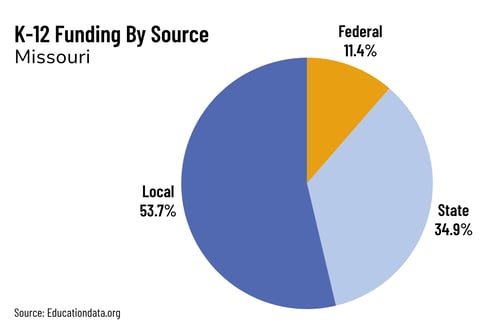
Breakdown for graphic: Federal 11.4%, State 34.9%, Local 53.7%
Funding Breakdown (Per Pupil):
Federal: $2,004
State: $6,159
Local: $9,464
While being slightly above the national average of 13.6% federal funding, Missouri relies heavily on state and local revenue. Federal funding accounts for 11.4% of all K-12 school spending in the Show-Me State, with the state ranked 36th in K-12 education funding and 37th in spending.
How K-12 Funding Works in Missouri
Public education funding in Missouri is governed by the Missouri Foundation Formula, the state’s primary mechanism for allocating resources across school districts. The formula is designed to support adequacy-based funding, with the Missouri Department of Elementary and Secondary Education (DESE) determining how state, local, and federal dollars are distributed.
At its core, the model is intended to ensure that every student has access to a baseline level of education, regardless of geographic location or local wealth.
Core Components of the Formula
State aid is calculated using four primary variables:
Weighted Average Daily Attendance (WADA) Student attendance adjusted for additional needs, including special education, English learners, and students eligible for free or reduced-price meals.
State Adequacy Target (SAT) A per-student funding benchmark derived from spending levels in high-performing districts.
Dollar Value Modifier (DVM) A regional adjustment that accounts for differences in cost of living, providing incremental increases for districts in higher-cost areas such as St. Louis and Kansas City.
Local Effort The expected contribution from local property taxes, based on 2005 valuation levels. This figure remains fixed, creating long-term disparities between districts with different tax bases.
The formula is expressed as:
State Funding = (WADA × SAT × DVM) – Local Effort
Additional Structural Elements
Several supplemental provisions shape how funding is distributed:
Proposition C A statewide 1% sales tax dedicated to education, distributed based on student attendance.
Hold-Harmless Provision Guarantees that districts do not receive less funding than in prior years, even with declining enrollment or changes in property values.
Transportation Funding Intended to cover up to 75% of eligible costs, though legislative caps and underfunding frequently reduce actual reimbursement levels.
Missouri is also in the process of modifying how student counts are calculated. Beginning in FY26, the state is transitioning toward a weighted membership model, with a planned 50/50 balance between attendance and enrollment by 2030. The objective is to provide greater funding stability for districts with fluctuating attendance patterns.
Structural Pressures on the Funding Model
District leaders across Missouri continue to navigate several persistent financial challenges:
Projected budget shortfalls approaching $1 billion by 2027
State Adequacy Target levels that lag actual cost requirements
Property tax relief policies that constrain local revenue growth
Transportation funding remains a consistent pressure point. In rural districts, where busing is essential, reimbursement levels frequently fall short of statutory targets. Districts often reallocate instructional funds to maintain transportation services.
Teacher compensation presents another ongoing issue. Missouri ranks near the bottom nationally in teacher pay, contributing to retention challenges. Legislative action through Senate Bill 727 established minimum salary thresholds, though workforce sentiment remains strained. A recent Missouri State Teachers Association survey found that 71% of educators are considering leaving the profession, citing compensation, workload, and limited support.
Case Study: District-Level Variability
Funding outcomes vary significantly based on local wealth, demographics, and tax capacity.
District Type
Avg. Enrollment
Per-Pupil Spending
High-Wealth
~8,500
$18,000–$25,000+
Middle-Income
~3,800
$13,000–$16,000
Low-Income
~1,200
$10,000–$12,500
High-wealth districts rely heavily on local property taxes, generating substantial revenue from strong commercial and residential tax bases. State aid represents a smaller portion of total funding.
Middle-income districts operate within the narrowest margin. Increases in local property values reduce state aid, while tax limitations restrict the ability to generate additional revenue. SAT levels in the $6,000–$7,000 range have drawn criticism for failing to support expanded needs such as school safety and mental health services.
Low-income districts depend more heavily on state and federal funding. Limited property wealth and reduced commercial activity constrain local revenue, often resulting in funding gaps relative to student needs.
Two consistent dynamics emerge:
Local wealth significantly influences total available funding
Middle-income districts experience the greatest structural pressure
Where School Safety Fits In
The expiration of ESSER funding has increased pressure on districts to sustain investments in safety and technology without federal relief.
The SETDA 2025 State EdTech Trends Report identifies funding as the largest unmet need across districts, with only 6% planning to sustain ESSER-supported initiatives.
Priority areas include:
Artificial intelligence
Cybersecurity
Broadband infrastructure
School safety now intersects directly with these priorities, alongside student support services and operational continuity.
Grant Finder: Federal Opportunities
Several federal programs remain relevant for Missouri districts entering FY26, despite evolving timelines and oversight structures:
COPS School Violence Prevention Program (SVPP)
Funding for physical security measures, emergency communications, and coordination with law enforcement
Covers up to 75% of project costs
DOJ STOP School Violence Grant
Supports threat assessment teams, training, and violence prevention technologies
Homeland Security Grant Program (HSGP)
Funds planning, equipment, and preparedness activities
Requires coordination through State Administrative Agencies
Nonprofit Security Grant Program (NSGP)
Focuses on threat mitigation, cybersecurity, and physical security enhancements
Stronger Connections Grant Program (SCG)
Supports school climate, safety planning, and student wellness initiatives
Application timelines for FY26 remain fluid. Districts benefit from tracking prior-year cycles and monitoring platforms such as SchoolSafety.gov and Grants.gov.
Federal program administration may also shift, with agencies such as the Department of Health and Human Services expanding their role in areas such as mental health and recovery programs, including Project SERV.
State and Non-Federal Funding Pathways
DESE oversees the distribution of state and federal funds, along with the administration of targeted grant programs. These include:
Support for low-income and students with special needs
Teacher development and school improvement initiatives
After-school and extended learning programs
Targeted intervention grants
Additional funding opportunities are accessible through grant discovery platforms such as GrantWatch and GrantPortal, as well as vendor-supported resources like the CDW Education Funding portal.
Alyssa’s Law in Missouri
Missouri lawmakers continue to evaluate legislation aligned with Alyssa’s Law, which would require schools to implement silent panic alert systems and coordinated emergency response protocols.
Potential deployment models include:
Mobile applications
Wearable alert devices
Fixed hardware installations
The legislation remains under review, while national adoption of rapid-response safety tools continues to expand.
Applying Strategically
Competitive grants favor districts that align funding requests with clearly defined outcomes. Strong applications typically connect:
Districts that demonstrate alignment between funding, safety priorities, and operational impact are better positioned to secure awards.
Kokomo24/7® supports districts through funding identification, strategic alignment, and application planning.
Final Takeaway
The FY26 funding environment is shaped less by the availability of resources and more by structural complexity across federal, state, and local systems.
Missouri reflects broader national dynamics. Funding formulas, local revenue capacity, and policy shifts collectively influence how resources reach districts. Variability across communities remains a defining characteristic, with local wealth continuing to drive disparities in per-student investment.
Districts that diversify funding sources, monitor policy developments, and act early on grant opportunities are better positioned to sustain safety initiatives, support innovation, and maintain operational stability.
K-12 funding will remain a central issue across the education sector. Disciplined planning, financial oversight, and strategic partnerships continue to define long-term success.
About Kokomo24/7®
Kokomo Solutions, Inc. (Kokomo24/7®) is an enterprise B2B software company founded and based in Chicago, IL, featuring a flexible software platform with proven solutions around health, safety, and operational use cases serving over 100 enterprise clients, including many education institutions, corporations, and municipalities.
Kokomo24/7® offers schools and workplaces a holistic platform for health, safety, and operational efficiency. Most organizations are inundated with fragmented solutions and struggle to provide streamlined services. Adopt a platform that can grow with you.

 CASES™
 ESCALATE™
 TRIAGE™
 NOTIFY™
 FORMS™
 ANALYTICS™
 HOST™
HOST™ OWLPASS®
 ACCESS™
 WELLNESS™
 CREDENTIALS™