FY27 K-12 Funding in Georgia: Navigating an Evolving Funding Landscape
For K-12 school districts, funding is no longer just an annual budgeting exercise. It is a year-round strategic priority that influences staffing, technology, student services, school safety, and long-term capital planning.
As FY27 gets underway, Georgia districts are navigating many of the same challenges facing school leaders nationwide: rising operating costs, changing federal priorities, cybersecurity requirements, behavioral health needs, and growing expectations around emergency preparedness.
That leaves district leaders asking familiar questions:
- How stable are future funding allocations?
- Which grant programs remain available?
- How can programs be sustained after temporary funding expires?
- Where should school safety investments fit into long-term financial planning?
Georgia's answer begins with a funding system that has been in place for more than four decades.
Grant Finder: Georgia
Every state in Kokomo24/7®'s Grant Finder series has its own funding structure, priorities, and opportunities.
In Georgia, the foundation is the Quality Basic Education (QBE) Act, the state's primary mechanism for distributing K-12 education funding since 1985.
QBE determines state funding based on student enrollment, instructional programs, personnel costs, and other operational factors. Rather than providing the same amount for every student, the formula recognizes that different educational programs require different levels of resources.
That makes QBE the starting point for understanding Georgia's K-12 funding landscape.
How QBE Works
Georgia measures enrollment using Full-Time Equivalent (FTE) student counts.
Students are counted based on the instructional programs in which they participate, and those programs receive different funding weights. Programs requiring additional resources can therefore generate more funding than the standard base program.
QBE funding calculations account for factors such as:
- Student enrollment
- Instructional program
- Teacher training and experience
- Direct instructional costs
- School and district operational costs
- Employee health benefit costs
- Additional state grants and supplements
The result is a weighted funding system designed to better reflect the cost of educating different student populations.
But QBE is only one part of the equation.
Local Funding and Equalization
Georgia districts also rely heavily on local revenue, particularly property taxes.
The QBE formula incorporates a required local contribution commonly known as the Local Five Mill Share. The calculation reflects local property wealth and is used when determining the state's contribution to each district.
That creates an important challenge.
Property wealth varies significantly across Georgia, which means districts do not have equal capacity to generate local education revenue.
Georgia addresses some of that disparity through Equalization Grants, which provide additional state assistance to qualifying districts with lower property wealth per student.
The objective is to reduce the gap between communities with significantly different local tax bases while preserving the role of local funding in public education.
FY27 Funding at a Glance
Georgia continues to make substantial investments in public education.
The state's FY27 budget provides approximately $14.23 billion in state funds for the Georgia Department of Education, an increase of approximately $532.6 million compared with the original FY26 budget.
Those dollars support QBE and a broad range of education priorities, including enrollment and program adjustments, employee benefit costs, literacy, transportation, capital investments, and student support services.
Georgia's funding environment is therefore not defined by one program or one source of revenue.
State appropriations work alongside local revenue and targeted federal funding to support the broader K-12 ecosystem.
For district leaders, the challenge is understanding how those resources fit together and where supplemental funding can support strategic priorities.
That becomes particularly important for school safety.
Georgia has significantly strengthened its school safety requirements in recent years, including the passage of HB 268 in 2025. The legislation established new requirements involving panic alert technology, school mapping, emergency preparedness, student safety, and behavioral supports.
Those requirements create an important connection between policy, funding, and technology.
In this edition of Grant Finder, we examine how Georgia's funding system works, where school safety fits within the state's investment strategy, and which funding opportunities districts should monitor as they plan for FY27 and beyond.
How K-12 Funding Works in Georgia
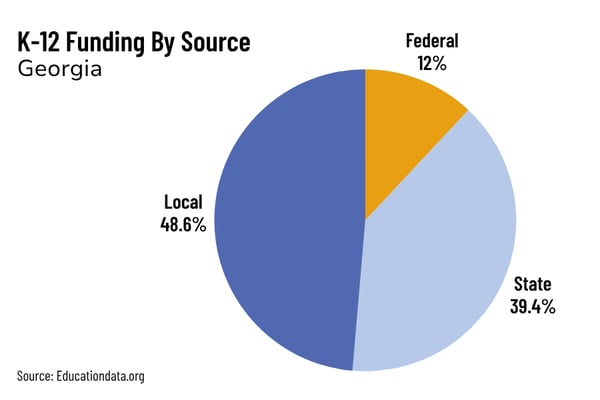
Georgia funds public education through three primary sources: state, local, and federal funding. The challenge for district leaders is understanding how those dollars interact and what each funding source can support.
The Three Primary Funding Sources
State Funding
State funding is distributed primarily through the Quality Basic Education (QBE) formula.
QBE supports core district operations and accounts for factors including student enrollment, instructional programs, teacher training and experience, employee benefit costs, and other operational needs.
Additional state appropriations support priorities such as special education, career and technical education, transportation, literacy, capital improvements, student services, and school safety.
For FY27, Georgia's budget provides approximately $14.23 billion in state funds for the Georgia Department of Education, reinforcing the state's significant role in supporting public education.
Local Funding
Local revenue remains another major component of Georgia's K-12 funding model, with property taxes providing much of that support.
Districts may also use voter-approved Education Special Purpose Local Option Sales Tax (E-SPLOST) revenue for eligible capital projects. Depending on local priorities and ballot authorization, these investments can support facilities, technology, infrastructure, and school safety improvements.
The ability to generate local revenue, however, varies considerably from one community to another. That is why mechanisms such as Georgia's Equalization Grants remain important for districts with lower property wealth.
Federal Funding
Federal dollars represent a smaller portion of overall K-12 revenue but remain important for targeted student populations and district priorities.
Major programs include:
- Title I for schools and students experiencing economic disadvantage
- IDEA for special education
- Title II for educator development and support
- Title III for English learners
- Title IV for student support, academic enrichment, technology, and safe and healthy schools
Unlike general state or local revenue, federal funding typically comes with defined eligibility requirements, allowable uses, and reporting obligations.
That makes federal dollars an important supplement rather than a replacement for state and local funding.
Building a Layered Funding Strategy
For district leaders, the real opportunity is not simply identifying how much funding is available. It is determining which funding source best aligns with each strategic priority.
A district modernizing its safety infrastructure, for example, might use local capital funding for facility improvements, state dollars for ongoing safety programs, and federal grants for eligible prevention or emergency preparedness initiatives.
This layered approach can help districts:
- Extend available resources across multiple projects
- Reduce dependence on a single funding source
- Support both immediate and long-term priorities
- Avoid duplication or funding compliance issues
- Build toward sustainable districtwide modernization
That becomes increasingly important as districts move beyond one-time technology purchases toward integrated, long-term safety strategies.
For Georgia districts, this is also where funding and policy are beginning to converge.
Recent state investments and new school safety requirements are creating a stronger connection between how districts fund safety, what they are required to implement, and how those systems work together.
And that brings us to one of the most important areas of Georgia's FY27 funding landscape: school safety.
Where School Safety Fits in Georgia’s Funding Model
School safety has become a significant investment priority in Georgia, with state funding increasingly tied to emergency preparedness, physical security, behavioral intervention, and faster coordination with first responders.
State Investment in School Safety
Georgia has made substantial investments in school safety in recent years, giving districts flexibility to address local priorities.
Funding can support initiatives such as:
- Emergency communications and panic alert systems
- Visitor management and access control
- Security cameras and other physical security improvements
- School safety personnel
- Behavioral and mental health supports
- Emergency preparedness and response
This flexibility is important because every district has different facilities, existing technology, staffing models, and safety needs.
Rather than approaching school safety as a single technology purchase, districts can use available funding to build a broader safety ecosystem that supports both prevention and response.
New Requirements Are Changing the Landscape
Georgia's approach to school safety has also evolved through legislation.
Following the September 2024 shooting at Apalachee High School, state leaders enacted House Bill 268, which established additional school safety requirements.
Beginning July 1, 2026, public schools are required to implement several measures, including:
- Mobile panic alert systems
- School mapping capabilities
- Anonymous reporting mechanisms
- Enhanced coordination with law enforcement and emergency response agencies
The legislation also addresses behavioral intervention and school climate, reinforcing the importance of identifying and responding to concerns before they escalate.
For districts, these requirements make interoperability increasingly important. A panic button, map, reporting system, or communications platform delivers greater operational value when information can move quickly between school personnel, district teams, 911 centers, and first responders.
Ricky and Alyssa’s Law
Georgia's school safety requirements include provisions commonly associated with Alyssa's Law, which focuses on accelerating emergency notification and law enforcement response during life-threatening incidents.
For district leaders, the issue is no longer simply whether panic alert technology should be part of the safety strategy. The larger question is how that technology fits within the district's emergency response ecosystem.
A panic alert should not operate in isolation. It should support a coordinated workflow that helps the appropriate people understand:
What happened → Where it happened → Who needs to respond → What happens next
That distinction matters when districts evaluate new safety investments.
Funding the Broader Safety Strategy
State funding is only one potential resource.
Georgia districts can build a layered strategy that combines state appropriations with local capital funding and eligible federal grants. E-SPLOST, for example, can provide locally approved funding for eligible capital improvements, including technology and infrastructure projects identified by the district.
Federal programs may provide additional opportunities.
The COPS School Violence Prevention Program (SVPP) can support eligible security improvements such as access control, emergency communications, locks, lighting, and other violence-prevention technologies.
The STOP School Violence Program focuses more heavily on prevention and can support initiatives such as:
- Behavioral Threat Assessment
- Anonymous reporting
- Violence-prevention training
- Intervention programs
- School safety education
Other federal programs may support emergency preparedness, communications, cybersecurity, student wellness, or related initiatives depending on the specific funding cycle and eligibility requirements.
Because grant availability, deadlines, and allowable uses can change, districts should verify current program requirements before building a project around a particular funding source.
From Funding to Strategy
The strongest school safety investments are rarely built around a single grant or product.
Instead, districts can start with the operational need and determine which funding sources can appropriately support each component.
For example, state funding might support a panic alert requirement, local capital dollars could modernize physical infrastructure, and an eligible federal grant could strengthen prevention or emergency communications.
The objective is not simply to spend available funding. It is to use that funding to build a coordinated, sustainable safety environment that can evolve as Georgia's requirements and district needs change.
That makes early planning especially important as districts move further into FY27.
Planning Strategically for FY27
Georgia's K-12 funding environment gives districts multiple ways to support school safety, technology, behavioral health, and emergency preparedness. The challenge is aligning those resources with the right priorities.
Because state, local, and federal funding programs operate under different timelines, eligibility requirements, and allowable uses, districts benefit from planning before funding opportunities open.
Strong funding strategies begin with four questions:
- What problem are we trying to solve?
- What solution addresses that need?
- What measurable benefit will it provide?
- Are we prepared to implement and sustain it?
A useful framework is:
Mission → Solution → Measurable Benefit → Implementation Readiness
This shifts the conversation away from purchasing individual products and toward building sustainable capabilities.
For school safety projects, that distinction matters. Districts may be able to fund individual components through different sources, but those investments should ultimately contribute to a coordinated districtwide strategy.
Think Beyond a Single Funding Cycle
Georgia districts should also consider what happens after the initial funding is spent.
A grant may help launch a new initiative, but districts still need to account for ongoing costs such as licensing, maintenance, training, staffing, upgrades, and system integration.
That makes sustainability an important part of funding decisions.
Rather than adding another standalone application every time funding becomes available, districts can evaluate whether new investments strengthen the systems and workflows already in place.
The goal should be to use available funding to reduce fragmentation, improve interoperability, and create infrastructure that can grow alongside the district.
How Kokomo24/7® Supports School Safety
Kokomo24/7® helps districts bring critical school safety functions together within a unified platform.
Core capabilities include:
- Behavioral Threat Assessment
- Visitor Management
- Incident Management
- Panic Button and Emergency Response
- Emergency Communications
- Analytics and Reporting
Instead of managing separate tools for individual safety functions, districts can connect workflows and information across a common environment.
That can help improve situational awareness, simplify administration, strengthen coordination, and reduce the complexity associated with disconnected safety systems.
For Georgia districts evaluating FY27 investments, this approach also provides a path toward long-term modernization. Funding can be applied strategically over time while districts continue building toward a more connected safety ecosystem.
Final Takeaway
Georgia's K-12 funding landscape is evolving, even as the Quality Basic Education formula remains at the center of the state's funding model.
District leaders must balance state allocations, local revenue, federal programs, and competitive grants while responding to growing expectations around behavioral health, technology, emergency preparedness, and school safety.
New school safety requirements make that planning even more important.
The opportunity for districts is to look beyond individual funding cycles and consider how each investment contributes to a broader strategy. State funding may address one priority, local capital resources another, and federal grants a third. When those investments work together, districts can make available dollars go further while building systems designed for long-term use.
For FY27 and beyond, the districts best positioned for success will be those that plan early, understand their funding options, prioritize interoperability, and connect every investment to a clearly defined operational need.
Funding may come from multiple sources. The strategy behind it should be unified.
About Kokomo24/7®
Kokomo Solutions, Inc. (Kokomo24/7®) provides an integrated platform supporting health, safety, and operational use cases for education institutions, corporations, and municipalities.
For K-12 districts, Kokomo24/7® brings critical safety workflows together in one environment, helping organizations reduce fragmentation while strengthening coordination, visibility, and operational efficiency.
Ready to explore how Kokomo24/7® can support your district's school safety strategy? Request a demo today.

 CASES™
 ESCALATE™
 TRIAGE™
 NOTIFY™
 FORMS™
 ANALYTICS™
 HOST™
HOST™ OWLPASS®
 ACCESS™
 WELLNESS™
 CREDENTIALS™