Washington puts more responsibility for funding public education on the state than many districts elsewhere in the country may be accustomed to.
That is not simply a budgetary choice. Washington's constitution declares that making ample provision for the education of all children is the state's "paramount duty," a principle that has shaped decades of education policy and funding decisions.
The landmark McCleary litigation reinforced that responsibility, ultimately requiring the state to address shortcomings in how it funded basic education.
Today, Washington distributes much of its K-12 funding through the Prototypical School Funding Model, which uses student enrollment and legislatively established assumptions about staffing and operating resources to calculate allocations. OSPI then distributes state funding to districts.
But a state-centered funding system does not mean every district need is fully funded.
That distinction is critical for FY27.
Districts must still navigate state allocations, categorical programs, local enrichment levies, Local Effort Assistance, federal programs, capital resources, and competitive grants to fund priorities beyond the state’s basic education framework.
And the framework itself is being examined. Washington lawmakers have directed OSPI to convene an Equitable School Funding Workgroup to analyze the Prototypical School Funding Model and consider alternative approaches.
For district leaders, the immediate challenge is therefore not simply finding more money.
It is understanding where the state-funded baseline ends, which priorities require additional resources, and how different funding streams can be combined without creating an unsustainable long-term obligation.
Few priorities expose that challenge more clearly than school safety.
Physical security, behavioral intervention, emergency communications, visitor management, mental health, staffing, training, and incident response can cross multiple funding categories.
Washington has also raised the operational standard. Under the state's 2025 Alyssa's Law, districts must work with law enforcement, public safety answering points, and safety and security staff to develop emergency response systems incorporating qualifying response technology.
That changes the funding conversation.
The question is no longer whether modern emergency-response capability belongs in the district's safety strategy. The question is how to fund, integrate, and sustain it.
How K-12 Funding Works in Washington
Washington's funding structure is unusually state-centered.
According to OSPI, approximately 78% of public-school funding comes from the state, 15% from local levies, and 7% from federal revenue.
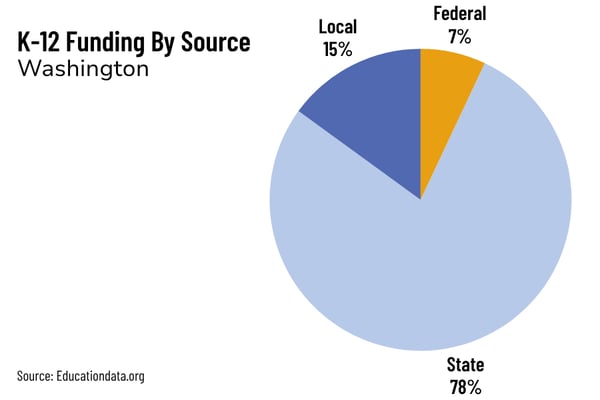
Those percentages matter, but the more important distinction is what each source is expected to support.
State Funding: The Foundation
Most state funding is calculated through Washington's Prototypical School Funding Model (PSFM).
Rather than funding each district based on its historical spending, the model uses hypothetical schools to calculate staffing and resource allocations. The prototypes assume:
- 400 students in an elementary school
- 432 students in a middle school
- 600 students in a high school
The formula establishes staffing assumptions for positions such as teachers, principals, nurses, counselors, social workers, and other school personnel. District enrollment is then used to calculate funding, with OSPI distributing the state allocations.
Washington also provides targeted funding for specific student populations and programs, including special education, the Learning Assistance Program, multilingual learners, Career and Technical Education, and transportation.
The model creates a substantial state-funded foundation.
It does not eliminate funding gaps.
In fact, Washington is currently examining the model itself. The Legislature directed OSPI to convene a K-12 Funding Equity Workgroup to examine the impact of the prototypical formula, economic disparities among communities, local revenue, and funding for specific student populations.
For FY27 planning, however, districts still must operate within the existing framework.
Local Funding: Beyond the State-Funded Baseline
Local enrichment levies provide resources beyond what the Legislature funds as basic education.
OSPI identifies uses including student support services, technology, classroom materials, extracurricular programs, and staff positions that are not fully funded by the state. And local funding remains significant: 283 Washington districts, or 96%, have an active levy in calendar year 2026.
But local capacity is not equal.
Washington uses Local Effort Assistance (LEA) to provide additional state support to eligible districts with lower property valuations that would otherwise have greater difficulty generating comparable revenue through local levies.
That distinction becomes important when districts need to fund priorities extending beyond the state-funded baseline.
Federal Funding: Targeted Support
Federal dollars represent the smallest share of Washington's overall K-12 funding, but their importance can be much greater for individual districts. OSPI notes that federal revenue accounts for more than 30% of the budget in some rural districts.
Programs including Title I, IDEA, Title II, Title III, and Title IV can support specific student populations and eligible educational priorities, but those dollars come with their own allowable uses, requirements, and funding timelines.
That means state, local, and federal dollars are not interchangeable.
For district leaders, the strategic question is therefore not simply:
Where can we find funding?
It is:
Which funding source can appropriately support this priority, and how will we sustain it when that funding ends?
That question becomes particularly important when the priority is school safety.
School Safety Crosses the Funding Lines
Washington's funding model creates a clear baseline for basic education.
School safety does not fit as neatly within those boundaries.
A comprehensive safety strategy can involve physical security, behavioral health, threat assessment, emergency communications, visitor management, staff training, incident response, and coordination with first responders. Those needs can cross state allocations, local levies and capital funding, and targeted federal programs.
The safety strategy may be unified. The funding behind it often is not.
Washington Has Built a Statewide Safety Framework
The state has established infrastructure to help districts coordinate that work.
Washington's School Safety Center, housed within OSPI, supports districts and schools in areas including emergency operations planning, behavioral threat assessment, crisis response, school climate, and other safety and preparedness priorities. (ospi.k12.wa.us)
Washington also operates a network of regional school safety centers through its Educational Service Districts, providing districts with regional support and expertise. (ospi.k12.wa.us)
That infrastructure is important, but guidance and coordination do not eliminate the need to fund implementation.
A district may still need resources for secure entrances, access control, emergency communications, behavioral health personnel, visitor management, training, or other safety improvements. Depending on the project, those costs may fall across different funding sources.
One Strategy, Multiple Sources
Federal programs can provide another layer.
The COPS School Violence Prevention Program has supported eligible security improvements and coordination with law enforcement, while the STOP School Violence Program has supported prevention-focused activities such as Behavioral Threat Assessment, training, anonymous reporting, and intervention.
Local funding may also support safety priorities beyond what the state provides, while capital resources can become important when improvements involve school facilities or physical security.
The result is a funding puzzle districts must assemble.
That is why school safety planning should start with the operational need, not the available grant.
Define the problem. Determine the capability required. Then identify the appropriate funding source.
Otherwise, districts risk building their safety environment one grant at a time: one program funds visitor management, another supports emergency communications, another addresses behavioral intervention, and another improves physical security.
Each investment may be worthwhile. Together, they can still create a fragmented environment if there is no common strategy behind them.
Do not build the safety strategy around the grant. Build the funding plan around the safety strategy.
That principle has become even more important in Washington because the state has moved beyond encouraging modern emergency-response capabilities.
It has put requirements into law.
Alyssa’s Law Changes the Conversation
Washington has already raised the baseline for emergency preparedness.
The state's Alyssa's Law took effect July 27, 2025, requiring school districts to collaborate with local law enforcement, public safety answering points, and safety and security staff to develop an emergency response system using evolving technology. The requirements also apply to charter schools and state-tribal education compact schools.
Importantly, Washington does not mandate one specific technology.
An emergency response system must include at least one qualifying capability, such as:
- Panic or alert buttons connected to school, district, and emergency responders
- Live video or audio feeds accessible to designated responders
- Remote door access
- Interactive two-way communications
- A qualifying system that meets applicable state building-code requirements
Districts were also required to report implementation progress to OSPI by October 1, 2025.
That flexibility creates an important distinction for FY27 planning.
Compliance establishes the minimum. Strategy determines the capability.
A district could satisfy the statutory requirement with one qualifying component. But district leaders should consider the broader operational question: What happens after an alert is initiated?
Who receives it? How is the location identified? Who is responsible for responding? When does the incident escalate? How are administrators and first responders coordinated? How is the response documented?
Those questions move the conversation beyond purchasing a panic button and toward building a coordinated emergency-response environment.
For districts evaluating new investments, that means looking for technology that can support the immediate requirement while also connecting with existing communications, incident management, visitor management, mapping, and other safety processes.
The objective should not be to buy technology for Alyssa's Law. It should be to use the requirement as an opportunity to strengthen the district's overall safety strategy.
Planning for FY27 and Beyond
Washington districts cannot control when every grant opens, how federal priorities change, or how the state's funding model may evolve.
They can control whether they are prepared when funding becomes available.
That starts by reversing the traditional grant conversation. Instead of finding an opportunity and then deciding what to buy, districts should define the need first.
A useful framework is:
Mission → Solution → Measurable Benefit → Implementation Readiness
For school safety, that means understanding the operational problem, identifying the capability required, determining how success will be measured, and knowing how the investment will be implemented and sustained.
A grant may help purchase technology. It does not automatically fund future licensing, training, staffing, maintenance, integrations, or expansion.
Winning the grant is not the strategy. Sustaining the capability is.
Think Beyond the Individual Grant
This matters because safety investments are often made incrementally.
One funding cycle supports visitor management. Another adds emergency communications. Capital funding improves access control. A federal opportunity supports Behavioral Threat Assessment or prevention.
Each project may solve a legitimate problem.
But districts should be careful that incremental funding does not create incremental infrastructure.
Before pursuing the next opportunity, leaders should ask:
- Does the investment support an established district priority?
- Can it work with systems already in place?
- Can the district sustain it when the initial funding ends?
- Can it scale across schools and use cases?
- Does it improve coordination or create another silo?
Washington's Alyssa's Law makes that last question particularly important. Meeting an emergency-response requirement should strengthen the broader safety environment rather than introduce another disconnected technology.
How Kokomo24/7® Supports a Connected Strategy
Kokomo24/7® helps districts connect critical health, safety, and operational functions within a unified platform.
Core capabilities include:
- Behavioral Threat Assessment
- Visitor Management
- Incident Management
- Panic Button and Emergency Response
- Emergency Communications
- Analytics and Reporting
That approach aligns with the reality of Washington's funding environment.
Different components of a district's safety strategy may be funded through different sources and at different times. They can still contribute to the same operational ecosystem.
A visitor concern can become an incident. A behavioral concern may require assessment and intervention. An emergency alert can initiate a predefined response. Communications can reach the appropriate stakeholders. Follow-up can be documented and analyzed.
Funding may be fragmented. School safety should not be.
The Washington Funding Opportunity
Washington's K-12 funding system provides districts with a substantial state-funded foundation, supplemented by local and federal resources.
But the state's centralized model does not eliminate the need for strategic funding decisions.
District leaders still must determine where basic education funding ends, where local or categorical resources can help, when federal or competitive grants are appropriate, and how new investments will be sustained.
School safety makes those decisions particularly visible.
Physical security, behavioral intervention, emergency communications, visitor management, training, and incident response can cross multiple funding sources while contributing to the same objective.
For FY27 and beyond, the districts best positioned to navigate that environment will not simply be those that find the most grants.
They will be the ones that define the need first, identify the right funding for it, and make every investment part of a longer-term strategy.
Washington's funding model may be distinctive, but the principle is universal:
Do not build the strategy around the funding. Build the funding around the strategy.

 CASES™
 ESCALATE™
 TRIAGE™
 NOTIFY™
 FORMS™
 ANALYTICS™
 HOST™
HOST™ OWLPASS®
 ACCESS™
 WELLNESS™
 CREDENTIALS™