FY26 K-12 Funding in Florida: Planning for a More Complex Future
As districts prepare for FY26, one challenge continues to shape nearly every strategic decision: funding.
School leaders must balance rising operational costs, student support services, technology modernization, and school safety while navigating an increasingly complex mix of state, local, and federal funding sources. Although funding has always been central to K-12 education, today's challenge extends beyond securing dollars. Districts must understand where funding comes from, how programs interact, and how changing policies can influence long-term planning.
Across the country, administrators are facing many of the same questions:
- How stable are future funding allocations?
- Which grants remain available?
- How can districts sustain programs after temporary funding expires?
- Where should school safety investments fit into long-term financial planning?
These questions have become even more important as districts continue adjusting to the expiration of ESSER funding, changing federal priorities, and increasing expectations around technology, cybersecurity, mental health, and campus safety.
A Different Funding Model
Florida approaches K-12 funding differently than many other states.
Rather than relying primarily on local property wealth, the state uses the Florida Education Finance Program (FEFP) to distribute funding through a statewide formula centered on student enrollment. State revenue provides most of the funding, while local property taxes and federal programs supplement district budgets.
The result is a funding model designed to create greater consistency across districts while still allowing local communities to invest in additional priorities.
That does not mean funding is simple.
District leaders must still navigate multiple funding streams, competitive grants, categorical allocations, and legislative appropriations that each carry their own eligibility requirements, timelines, and reporting obligations. School safety initiatives, in particular, frequently require districts to combine several funding sources to support technology, infrastructure, emergency preparedness, and behavioral health programs.
Grant Finder: Florida
Every state featured in Kokomo24/7®'s Grant Finder series has its own funding structure, priorities, and opportunities.
Florida is no exception.
In this edition, we examine how Florida's funding system works, where school safety fits into the state's funding framework, and the grant opportunities districts should monitor as they prepare for FY26 and beyond.
Federal Funding: An Evolving Landscape
Although federal education funding often receives the greatest public attention, it represents a relatively small portion of total K-12 spending. Nationwide, federal dollars account for roughly 13-14% of education funding, with the majority coming from state and local sources.
Even so, federal policy continues to influence district planning.
Recent budget discussions, proposed restructuring within the U.S. Department of Education, and evolving grant administration have introduced additional uncertainty into long-term funding strategies. While core formula programs have largely remained intact, competitive grant programs and supplemental funding opportunities continue to evolve.
Districts are also managing broader financial pressures, including declining enrollment in some communities, growing cybersecurity requirements, expanding student wellness initiatives, and rising infrastructure costs.
For Florida districts, these national trends reinforce the importance of diversified funding strategies rather than relying on a single revenue source.
Successful districts increasingly build long-term financial plans that combine state allocations, local revenue, competitive grants, and federal funding opportunities to support both daily operations and future investments.
Florida at a Glance
According to the most recent financial data (FY24) available for the state:
- Per-pupil spending: approximately $12,689
- Total expenditure (including capital outlay): approximately $15,298 per student
- Total public funding per pupil: approximately $15,684
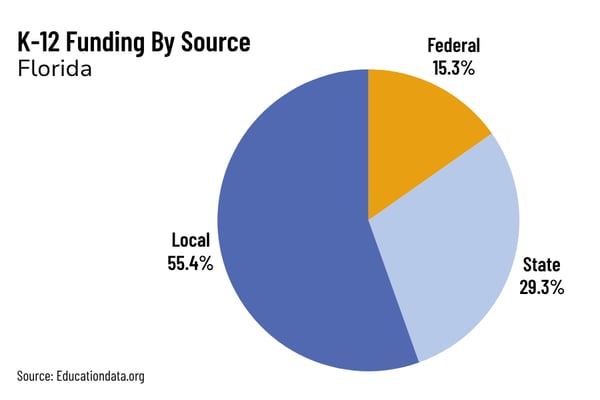
Funding Breakdown (Per Pupil):
- Federal: $2,392
- State: $4,595
- Local: $8,696
Per pupil, Florida ranks 47th in K-12 funding and 46th in spending. Federal funding reportedly represents 20.29% of total K-12 education spending, while current spending at K-12 schools is equivalent to 87.68% of total expenditures.
For district leaders, this means that understanding how Florida’s funding formula operates and where supplemental funding opportunities exist can make the difference between maintaining existing services and advancing strategic initiatives. This becomes even more important when you consider that over 50% of K-12 education funding is from local sources.
The next question becomes: how does Florida’s funding system actually work?
How K–12 Funding Works in Florida
Florida's education funding system is built around a simple principle: funding follows the student.
Unlike many states that rely heavily on local property wealth, Florida distributes most K–12 operating dollars through the Florida Education Finance Program (FEFP) a statewide funding formula that combines state appropriations with required local tax revenue. Rather than guaranteeing identical funding for every district, the FEFP is designed to provide a more equitable distribution of resources while recognizing differences in enrollment, student needs, and local revenue capacity.
For district leaders, understanding how the FEFP works is essential because it influences nearly every aspect of financial planning, from staffing and instructional programs to technology investments and school safety initiatives.
Funding Begins with Student Enrollment
At the center of Florida's funding model is Full-Time Equivalent (FTE) enrollment.
Each student generates funding based on the educational services they receive. The state then applies a series of weighted adjustments that recognize factors such as:
- Grade level
- Exceptional Student Education (ESE)
- English language learners
- Career and Technical Education (CTE)
- Other specialized instructional programs
These weighted allocations recognize that educating every student does not cost the same. Students requiring additional instructional or support services receive higher funding levels to help districts meet those needs.
Enrollment, therefore, is more than a student count, it directly shapes district revenue.
Where the Money Comes From
Florida's K-12 funding is supported through three primary sources:
State Funding
The largest share of education funding comes from state revenue appropriated by the Florida Legislature. These dollars support the FEFP along with numerous categorical programs dedicated to priorities such as instructional materials, transportation, mental health, and school safety.
Local Funding
Every district contributes a required local effort through property taxes established under state law. Districts may also generate additional local revenue through voter-approved initiatives where permitted.
Although local revenue remains important, Florida's funding model reduces the disparities often created by property wealth alone by balancing state and local contributions through the FEFP.
Federal Funding
Federal dollars generally account for a much smaller portion of district budgets and are directed toward specific programs rather than general operations. Common examples include:
- Title I
- IDEA Part B
- Title II
- Title III
- Title IV
These funds supplement state and local resources while supporting students with the greatest educational needs.
A More Centralized Funding Model
One of Florida's defining characteristics is the level of state oversight built into its education funding system.
The Legislature establishes annual education appropriations through the General Appropriations Act, while the Florida Department of Education administers funding, accountability requirements, and program implementation. Districts retain responsibility for local budgeting and operations, but they do so within a framework largely established at the state level.
This centralized approach creates greater consistency across Florida's 67 school districts, while allowing statewide priorities such as school safety, literacy, workforce development, and mental health, to receive dedicated funding through categorical appropriations.
School Choice and Funding
Florida has also become one of the nation's leading states for school choice.
Programs such as the Family Empowerment Scholarship, Florida Tax Credit Scholarship, and other education choice initiatives allow eligible students to direct state education funding toward private schools and alternative educational settings.
As funding follows the student, enrollment changes can directly affect district revenue.
For district leaders, this makes enrollment forecasting an increasingly important component of long-term financial planning. Even modest enrollment shifts can influence staffing decisions, instructional programming, capital planning, and future budget development.
Planning Beyond the Formula
While the FEFP provides the foundation for district operations, it rarely funds every priority.
Technology modernization, cybersecurity, emergency communications, visitor management systems, behavioral threat assessment programs, and campus security improvements often require districts to combine multiple funding sources.
Successful districts increasingly view funding as a layered strategy rather than relying on any single allocation. State appropriations establish the baseline, while federal grants, local capital funding, and competitive programs help accelerate larger initiatives.
That strategic approach becomes particularly important when planning investments in school safety, where funding opportunities often come from multiple agencies and operate on different timelines.
Where School Safety Fits in Florida's Funding Model
School safety has become one of Florida's highest education priorities.
Over the past decade, the state has made significant investments in campus security, emergency preparedness, student mental health, and behavioral threat assessment. Rather than relying on a single funding source, Florida supports school safety through a combination of recurring state appropriations, targeted grant programs, local capital funding, and federal opportunities.
For district leaders, the challenge is no longer whether funding exists, it is understanding which funding source best aligns with each initiative.
Safe Schools Allocation
The cornerstone of Florida's school safety funding is the Safe Schools Allocation, administered through the Florida Education Finance Program.
Unlike competitive grants, these funds are distributed annually to school districts using a statutory formula. The allocation is intended to help districts implement and sustain comprehensive school safety programs while meeting state requirements.
Districts commonly use these funds to support:
- School resource officers (SROs) and school guardians
- Campus security personnel
- Access control improvements
- Visitor management systems
- Emergency communications
- Security planning and coordination
- Safety equipment and related operational expenses
Because the funding is recurring, many districts use the Safe Schools Allocation to support ongoing operational needs rather than one-time capital investments.
Mental Health and Threat Assessment
Florida also recognizes that school safety extends beyond physical security.
State funding supports student mental health services, behavioral intervention, and multidisciplinary threat assessment teams that identify and assist students before concerning behaviors escalate into a crisis.
These investments complement physical security measures by helping districts strengthen prevention rather than relying solely on emergency response.
Funding may support:
- School-based mental health professionals
- Threat assessment teams
- Student intervention programs
- Suicide prevention initiatives
- Behavioral support services
- Professional development for educators and staff
This layered approach reflects the growing understanding that campus safety depends on both secure facilities and strong student support systems.
Capital Funding for Safety Improvements
While operational funding supports daily safety activities, larger infrastructure projects typically require separate funding.
Districts often rely on local capital improvement programs, bond proceeds, or dedicated capital outlay funds to finance projects such as:
- Secure entrances
- Building renovations
- Door hardening
- Camera systems
- Access control hardware
- Network infrastructure
- Campus communication systems
Unlike operational appropriations, these investments are designed to improve long-term physical security across school facilities.
For many districts, capital funding provides the foundation, while state and federal grants accelerate technology upgrades or expand existing safety initiatives.
School Hardening and Infrastructure Investments
Florida has also expanded its investment in school hardening following statewide efforts to strengthen campus security.
School hardening projects typically focus on reducing vulnerabilities through physical improvements such as:
- Controlled access points
- Reinforced entryways
- Security glazing
- Perimeter enhancements
- Surveillance technology
- Emergency communications infrastructure
These projects are often guided by district security assessments and recommendations developed in partnership with state agencies and local law enforcement.
Rather than viewing physical security as a standalone investment, many districts now incorporate these improvements into broader emergency preparedness and operational resilience strategies.
Layering Funding for Greater Impact
Few school safety projects rely on a single funding source.
Successful Florida districts increasingly combine multiple funding streams to maximize available resources while maintaining compliance with each program's requirements.
For example:
- State allocations may support ongoing staffing and operational costs.
- Local capital funding can finance major infrastructure improvements.
- Federal grants help districts expand technology, emergency preparedness, or violence prevention initiatives.
- Competitive programs provide additional funding for specialized projects.
This layered funding strategy allows districts to move beyond maintaining existing programs and begin modernizing school safety infrastructure over time.
Rather than treating funding opportunities independently, high-performing districts align available resources with long-term strategic priorities, ensuring each funding source complements, and does not duplicate the others.
Why Strategic Planning Matters
Because each funding program operates under different timelines, eligibility requirements, and allowable uses, early planning has become increasingly important.
Districts that identify priorities well before grant windows open are better positioned to:
- Build stronger funding applications.
- Coordinate projects across multiple funding sources.
- Avoid duplication or supplanting issues.
- Accelerate implementation once funding becomes available.
As federal and state priorities continue to evolve, proactive planning is becoming one of the strongest predictors of funding success.
Federal and Supplemental Funding Opportunities
While Florida provides substantial state funding for education and school safety, federal grants continue to play an important role in helping districts expand initiatives, modernize infrastructure, and strengthen emergency preparedness.
Unlike formula funding, most federal school safety programs are competitive. Successful applications clearly demonstrate a documented need, measurable outcomes, implementation readiness, and long-term sustainability.
Districts that monitor funding opportunities throughout the year, rather than waiting for application windows to open, are consistently better positioned to compete for available awards.
Federal Programs to Watch
Several federal grant programs remain particularly relevant for Florida districts preparing for FY26.
COPS School Violence Prevention Program (SVPP)
Administered by the U.S. Department of Justice, the School Violence Prevention Program (SVPP) supports physical security improvements designed to prevent violence before it occurs.
Eligible projects include:
- Visitor management systems
- Access control
- Panic buttons
- Emergency communications
- Security cameras
- Coordination with local law enforcement
SVPP typically funds up to 75% of eligible project costs, with applicants responsible for the required local match unless they qualify for an approved exception.
STOP School Violence Program
Also administered through the Department of Justice, the STOP School Violence Program focuses on prevention rather than physical infrastructure.
Funding commonly supports:
- Behavioral Threat Assessment programs
- Anonymous reporting systems
- Violence prevention training
- Student mental health initiatives
- School climate improvements
For districts expanding multidisciplinary threat assessment teams or early intervention programs, STOP funding can complement Florida's existing behavioral health investments.
Homeland Security Grant Program (HSGP)
The Homeland Security Grant Program provides funding for emergency preparedness, planning, communications, equipment, and training.
Projects often include:
- Emergency operations planning
- Incident command training
- Communications interoperability
- Critical infrastructure protection
Because HSGP funding flows through the state's designated administrative agency, districts typically coordinate applications through state emergency management partners.
Nonprofit Security Grant Program (NSGP)
Although primarily intended for nonprofit organizations, the NSGP may be relevant for eligible independent schools or nonprofit education partners seeking funding for physical security and cybersecurity improvements.
Stronger Connections Grant Program
Where available, the Stronger Connections Grant Program supports initiatives that improve school climate, student wellness, and violence prevention.
Districts have used these funds to strengthen behavioral support systems, expand student services, and improve overall school safety planning.
Looking Beyond Traditional Grants
Federal funding is only one piece of the puzzle.
Many Florida districts supplement state appropriations through additional funding sources, including:
- Local capital improvement programs
- Bond initiatives
- Education foundations
- Community partnerships
- Private and corporate foundations
- Technology-specific funding opportunities
Programs such as E-Rate can also offset eligible networking and telecommunications costs, allowing districts to redirect local funding toward broader technology and school safety initiatives.
The most successful districts rarely rely on a single grant. Instead, they combine multiple funding streams to support long-term modernization while maintaining operational flexibility.
Alyssa's Law and Florida's School Safety Landscape
Florida has played a significant role in shaping the national conversation around school safety.
Following the tragedy at Marjory Stoneman Douglas High School, the state implemented sweeping school safety reforms that continue to influence funding priorities nationwide.
Many of the technologies associated with Alyssa's Law, including silent panic alert systems, emergency communications, and rapid coordination with first responders, already align with projects commonly supported through both Florida appropriations and federal grant programs.
For districts planning future investments, this creates an opportunity to design projects that not only address current operational needs but also remain aligned with evolving legislative priorities.
As additional states consider Alyssa's Law legislation, districts that invest in scalable, interoperable safety technologies are likely to be better positioned for future funding opportunities.
Applying Strategically in FY26
Competitive funding programs continue to reward districts that demonstrate clear alignment between identified needs and measurable outcomes.
The strongest applications consistently connect four elements:
Mission → Solution → Measurable Benefit → Implementation Readiness
Successful applicants are able to clearly answer four questions:
- What problem are we trying to solve?
- Why is this problem important?
- How will the proposed solution address it?
- How will success be measured?
Districts that establish these connections early are typically better positioned to secure funding than those that focus primarily on the technology or product itself.
Grant reviewers increasingly want evidence that projects are part of a larger strategy rather than standalone purchases.
As competition for funding continues to increase, preparation remains one of the most valuable advantages a district can possess.
Kokomo24/7® works with districts to align school safety priorities with available funding opportunities, helping administrators identify funding pathways, strengthen applications, and connect safety initiatives to measurable operational outcomes.
Final Takeaway
Florida's K-12 funding model demonstrates that successful district planning depends on more than securing funding, it requires understanding how state, local, and federal resources work together.
While the Florida Education Finance Program provides the foundation for district operations, school safety, technology modernization, and student support services often require a layered funding strategy that combines recurring state allocations, local capital investments, and competitive grants.
As districts prepare for FY26 and beyond, those that plan early, diversify funding sources, and align projects with long-term priorities will be better positioned to strengthen school safety, support innovation, and maintain operational resilience.
Like every state featured in Kokomo24/7®'s Grant Finder series, Florida presents its own unique funding opportunities and challenges. Understanding how the state's funding system works is the first step toward building a sustainable strategy that supports students, staff, and the broader school community.
About Kokomo24/7®
Kokomo Solutions, Inc. (Kokomo24/7®) is an enterprise B2B software company founded and based in Chicago, IL, featuring a flexible software platform with proven solutions around health, safety, and operational use cases serving over 100 enterprise clients, including many education institutions, corporations, and municipalities.
Kokomo24/7® offers schools and workplaces a holistic platform for health, safety, and operational efficiency. Most organizations are inundated with fragmented solutions and struggle to provide streamlined services. Adopt a platform that can grow with you.
Request a demo to see the flexibility of the Kokomo24/7® platform for yourself!

 CASES™
 ESCALATE™
 TRIAGE™
 NOTIFY™
 FORMS™
 ANALYTICS™
 HOST™
HOST™ OWLPASS®
 ACCESS™
 WELLNESS™
 CREDENTIALS™