FY26 K-12 Funding: Understanding Michigan's Path to an Adequate Education
As one school year ends and planning for the next begins, district leaders across Michigan are facing a familiar challenge: how to secure the funding needed to support students, maintain operations, modernize infrastructure, and invest in school safety.
Funding has always been a central issue in K-12 education. What has changed is the level of complexity surrounding it. School districts are now operating in an environment shaped by shifting federal priorities, evolving grant requirements, changing enrollment patterns, and increasing expectations around student support, cybersecurity, technology modernization, and campus safety.
For Michigan districts preparing for FY26, understanding where funding comes from and how those funding streams interact has become just as important as understanding how much funding is available.
The reality is that funding uncertainty is no longer an occasional disruption. It has become a permanent feature of the K-12 landscape.
District leaders continue to ask the same fundamental questions:
- When will funds be released?
- What restrictions will govern their use?
- How stable are allocations from year to year?
- Which funding sources can support long-term priorities?
The answers are becoming increasingly difficult to predict.
As a result, successful districts are moving away from reactive budgeting and adopting more strategic funding models that incorporate diversified revenue streams, multi-year forecasting, and proactive grant planning.
Michigan provides a particularly interesting case study.
Unlike many states that rely heavily on local property taxes, Michigan operates one of the nation's most centralized school funding systems. State-controlled funding mechanisms, local revenue sources, categorical grants, and federal programs all play distinct roles in determining how resources reach school districts.
Understanding those relationships is critical for district leaders seeking to maintain operational stability while advancing educational outcomes and school safety initiatives.
Federal Funding: A Changing Landscape
Federal funding remains an important component of the K-12 funding ecosystem, but it represents a relatively small percentage of total education spending.
Nationally, federal dollars account for approximately 13% to 14% of K-12 funding. While those funds often support high-priority programs including Title I, IDEA, school nutrition, and school safety initiatives they are rarely sufficient to fund large-scale operational needs independently.
Recent developments at the federal level have introduced additional uncertainty into district planning.
Congress recently approved approximately $79 billion in funding for the U.S. Department of Education through September, preserving most major formula grant programs. At the same time, ongoing discussions around restructuring federal education responsibilities, reducing discretionary spending, and shifting program oversight to other agencies continue to create uncertainty for districts nationwide.
Secretary of Education Linda McMahon's "Returning Education to the States" initiative reflects a broader policy discussion around federal involvement in education. While many core programs remain intact, districts are increasingly monitoring potential changes to competitive grants, reporting requirements, compliance expectations, and program administration.
Even relatively small policy changes can affect:
- Application timelines
- Reporting requirements
- Grant eligibility criteria
- Program administration
- Long-term funding predictability
For district leaders, the challenge is not necessarily a lack of funding. Rather, it is the growing difficulty of forecasting how federal funding will evolve over time.
FY26 Risk Signals District Leaders Should Watch
Several national trends continue to influence funding decisions at the state and local level.
Enrollment Pressures
Student enrollment remains a critical driver of school funding nationwide.
Many districts continue to experience declining enrollment driven by demographic shifts, lower birth rates, expanded school choice programs, and regional population movement. Because many funding formulas are tied directly to student counts, enrollment fluctuations can have an immediate impact on district revenues.
Teacher Recruitment and Retention
Teacher compensation continues to place pressure on district budgets.
According to the National Education Association, average teacher salaries increased during the 2024-25 school year. However, when adjusted for inflation, educator purchasing power remains below levels seen a decade ago.
States across the country are considering compensation reforms, creating additional budgetary considerations for school districts.
Infrastructure Modernization
Districts continue to face significant infrastructure demands, including:
- Facility modernization
- HVAC replacement
- Technology upgrades
- Cybersecurity improvements
- School safety enhancements
- Deferred maintenance projects
The State of Our Schools 2025 report continues to rank K-12 education among the nation's largest public infrastructure investment categories.
While federal and state funding opportunities exist, much of this work still relies on local funding mechanisms and long-term capital planning.
Expanded Expectations
District responsibilities continue to expand beyond traditional classroom instruction.
Today's districts are expected to support:
- Student mental health
- School safety initiatives
- Behavioral threat assessment programs
- Cybersecurity readiness
- Technology modernization
- Emergency preparedness
- Regulatory compliance
Many funding streams remain highly restricted, making it difficult for districts to address emerging priorities without identifying supplemental funding sources.
Michigan at a Glance
Michigan's funding system differs from many other states because it relies heavily on centralized state funding mechanisms rather than local property tax revenue.
According to the most recent statewide financial data:
- Per-pupil spending averages approximately $18,314
- Total expenditures exceed $22,000 per student
- Total public funding averages approximately $23,222 per pupil
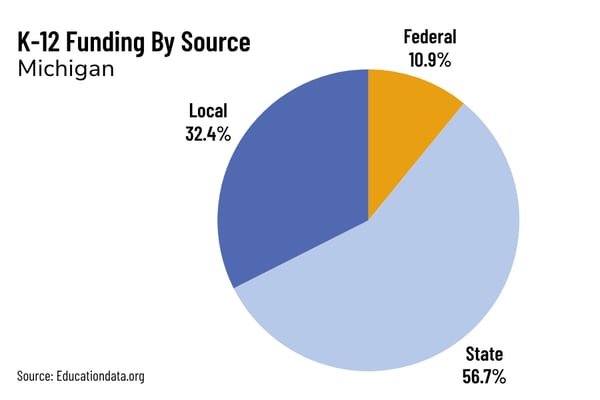
Funding Breakdown (Per Pupil):
- Federal: $2,530
- State: $13,161
- Local: $7,532
While Michigan ranks near the middle nationally for overall K-12 spending, those statewide averages often mask significant differences between districts.
The state's centralized funding model was designed to reduce disparities between wealthy and low-income communities. However, differences in local revenue capacity, enrollment trends, voter-approved bonds, and access to competitive grants continue to create meaningful variation across districts.
For district leaders, understanding how Michigan's funding formula operates and where supplemental funding opportunities exist can make the difference between maintaining existing services and advancing strategic initiatives.
The next question becomes: how does Michigan's funding system actually work?
How K-12 Funding Works in Michigan
Michigan operates one of the most centralized K-12 funding systems in the United States.
Unlike states that rely heavily on local property taxes to fund public education, Michigan shifted to a state-centered model following the passage of Proposal A in 1994. The legislation fundamentally changed how schools are funded, reducing dependence on local property taxes and creating a more equitable funding structure across districts.
The goal was straightforward: provide students with access to an adequate education regardless of where they live.
More than 30 years later, Proposal A continues to shape how funding flows through Michigan's education system.
At a high level, Michigan's funding structure is built on three primary components:
Foundation Allowance
The Foundation Allowance serves as the financial foundation for district operations.
This per-pupil allocation provides districts with the core funding necessary to support instructional programs, staffing, and day-to-day operations. The allowance is based on student enrollment and combines state and local revenue sources.
Districts receive a predetermined amount per student, with the state making up the difference when local revenue falls below the established funding level.
This approach is intended to reduce funding disparities between communities with different levels of property wealth.
School Aid Fund (SAF)
The School Aid Fund functions as Michigan's primary education funding reservoir.
The fund draws revenue from multiple sources, including:
-
Sales and use taxes
-
State income tax allocations
-
State Education Tax revenues
-
Michigan Lottery proceeds
-
Tobacco taxes
-
Real estate transfer taxes
-
Online gaming and sports betting revenues
These revenues are then distributed across foundation allowances, categorical grants, special education programs, transportation assistance, career and technical education initiatives, and targeted school safety programs.
For FY26, education spending supported through the School Aid Fund is expected to exceed $24 billion.
Federal Funding
Federal funding accounts for approximately 10% to 14% of Michigan's overall K-12 funding structure.
Unlike state formula funding, federal dollars are typically restricted to specific purposes, including:
-
Title I programs
-
Special education services
-
Student support initiatives
-
School nutrition programs
-
School safety programs
-
Technology and broadband initiatives
While federal funding remains important, districts generally view it as supplemental rather than foundational.
Understanding Michigan's Funding Challenge
Michigan's system was designed to improve equity, but it also creates several practical challenges for district leaders.
The state's funding model provides operational stability, yet many capital improvements and modernization projects fall outside traditional formula funding.
As a result, districts often find themselves managing two distinct funding conversations:
Operational Funding
Used for:
Capital and Modernization Funding
Used for:
-
Building renovations
-
Technology upgrades
-
Security infrastructure
-
Access control systems
-
Communications systems
-
Safety equipment
-
Facility improvements
The distinction matters because many school safety projects fall into the second category.
In practice, this means districts frequently need to combine multiple funding sources to fully support safety initiatives.
A district may use:
-
Foundation Allowance funding for personnel
-
State safety grants for technology
-
Local bonds for infrastructure improvements
-
Federal grants for emergency preparedness programs
Understanding how these funding streams interact is increasingly becoming a strategic advantage.
School Safety Funding in Michigan
School safety has evolved from a facilities issue into a strategic operational priority.
Today's districts are investing in a wide range of technologies and programs designed to improve emergency response, strengthen communications, enhance campus visibility, and support student wellness.
Michigan has responded by creating multiple funding pathways dedicated to school safety.
Section 31aa School Safety Funding
Section 31aa of the State School Aid Act remains one of Michigan's primary school safety funding mechanisms.
The program distributes funding through a combination of formula-based allocations and competitive grant opportunities.
Districts can use funding to support initiatives such as:
- Emergency Response Systems
- Threat Assessment Frameworks
- Interconnected Communication
Unlike many federal programs, Section 31aa provides districts with flexibility to address locally identified safety priorities.
School Safety Assessments and Critical Incident Mapping
Michigan has also invested in targeted programs designed to improve preparedness.
These initiatives include:
Section 97c
Supports comprehensive safety assessments conducted by qualified third parties.
- Provides micro-grants of up to $2,000 per building for K-12 schools to hire external vendors to audit physical structures for security vulnerabilities
Section 97d
Supports Critical Incident Mapping initiatives.
These digital maps provide first responders with rapid access to:
The goal is to reduce response times and improve situational awareness during emergencies.
Competitive School Safety Grant Program (CSSGP)
Administered through the Michigan State Police Office of School Safety, CSSGP provides districts with access to larger project-based funding opportunities.
Awards generally range from approximately $10,000 to $250,000 depending on project scope and demonstrated need.
Funding can support:
-
Access control systems
-
Visitor management solutions
-
Security technology upgrades
-
Emergency communications infrastructure
-
Physical security improvements
Because awards are competitive, districts that clearly demonstrate risk, readiness, and measurable outcomes tend to be more successful.
What Michigan District Leaders Should Know in FY26
Several trends are shaping school safety funding decisions across the state.
ESSER Funding Has Ended
Many districts used pandemic-era relief dollars to accelerate investments in technology, cybersecurity, and safety initiatives.
Those funding sources have largely expired.
Districts now face the challenge of sustaining programs without federal relief support.
Technology Modernization Remains a Priority
According to recent SETDA research, districts continue to prioritize:
Funding opportunities increasingly overlap across these categories.
Grants Are Becoming More Important
Districts can no longer rely solely on traditional operational funding to support modernization efforts.
Competitive grants, targeted safety programs, federal funding opportunities, and local capital initiatives are becoming increasingly important components of long-term planning.
For many districts, successful grant acquisition is no longer optional, it is becoming a core strategic capability.
Grant Finder: Federal Funding Opportunities for Michigan Districts
While Michigan's funding system is heavily supported by state revenue, federal grants continue to provide valuable opportunities for districts pursuing school safety, emergency preparedness, technology modernization, and student wellness initiatives.
The challenge is not identifying funding sources. It is aligning projects with the appropriate grant program and preparing applications well before submission windows open.
Several federal programs remain particularly relevant for Michigan districts entering FY26.
Grant Finder: Federal Opportunities
Several federal programs remain relevant for Michigan districts entering FY26, despite evolving timelines and oversight structures:
COPS School Violence Prevention Program (SVPP)
- Funding for physical security measures, emergency communications, and coordination with law enforcement
- Covers up to 75% of project costs
DOJ STOP School Violence Grant
- Supports threat assessment teams, training, and violence prevention technologies
Homeland Security Grant Program (HSGP)
- Funds planning, equipment, and preparedness activities
- Requires coordination through State Administrative Agencies
Nonprofit Security Grant Program (NSGP)
- Focuses on threat mitigation, cybersecurity, and physical security enhancements
Stronger Connections Grant Program (SCG)
- Supports school climate, safety planning, and student wellness initiatives
Application timelines for FY26 remain fluid. Districts benefit from tracking prior-year cycles and monitoring platforms such as SchoolSafety.gov and Grants.gov.
To learn more about how to apply for grants such as SVPP and what you should know before submitting an application, check out our recent blog post here.
Federal program administration may also shift, with agencies such as the Department of Health and Human Services expanding their role in areas such as mental health and recovery programs, including Project SERV.
The U.S. Department of Education has also announced a competition to bolster school safety and school infrastructure. According to a press release, a joint initiative between the DOE and Health and Human Services (HHS), the School Safety Enhancement program will attach to FY26, and not only will align federal funding with state goals but also create “more coherence across state systems.” You can read the full press release here.
State and Local Funding Pathways
Michigan districts often achieve the greatest success when they combine multiple funding sources rather than relying on a single grant or budget allocation.
A common mistake is viewing grants, bonds, and operational funding as competing resources.
Successful districts treat them as complementary funding tools.
Local Bonds and Sinking Funds
Because Michigan does not provide dedicated statewide funding for major capital improvements, local funding mechanisms remain critically important.
Many districts rely on voter-approved bonds and sinking funds to support:
These funding mechanisms provide long-term stability and are often used as the foundation for larger improvement initiatives.
Layering Grants with Local Funding
One of the most effective funding strategies involves combining local capital funding with state or federal grants.
For example:
-
A bond funds the initial infrastructure investment.
-
A state grant accelerates implementation.
-
A federal grant adds advanced technology or specialized capabilities.
This approach allows districts to maximize available resources while reducing pressure on local budgets.
The strongest funding strategies rarely depend on a single source of revenue.
Alyssa's Law in Michigan
Like many states, Michigan continues to evaluate legislation aligned with Alyssa's Law.
The legislation is designed to improve emergency response capabilities by requiring schools to implement silent panic alert technologies that connect directly with first responders and emergency personnel.
Potential solutions include:
-
Mobile panic applications
-
Wearable alert devices
-
Fixed panic alert hardware
-
Integrated emergency notification platforms
Although legislation remains under consideration, the broader trend is clear.
Across the country, school districts are increasingly investing in technologies that improve communication, reduce response times, and strengthen coordination during emergencies.
For district leaders, the question is becoming less about whether these technologies will be adopted and more about how they will be funded and integrated into existing safety strategies.
Applying Strategically in FY26
Competitive funding programs continue to reward districts that demonstrate clear alignment between identified needs and measurable outcomes.
The strongest applications consistently connect four elements:
Mission → Solution → Measurable Benefit → Implementation Readiness
Successful applicants are able to clearly answer four questions:
-
What problem are we trying to solve?
-
Why is this problem important?
-
How will the proposed solution address it?
-
How will success be measured?
Districts that establish these connections early are typically better positioned to secure funding than those that focus primarily on the technology or product itself.
Grant reviewers increasingly want evidence that projects are part of a larger strategy rather than standalone purchases.
As competition for funding continues to increase, preparation remains one of the most valuable advantages a district can possess.
Kokomo24/7® works with districts to align school safety priorities with available funding opportunities, helping administrators identify funding pathways, strengthen applications, and connect safety initiatives to measurable operational outcomes.
Final Takeaway
The FY26 funding environment nationally is shaped less by the availability of resources and more by structural complexity across federal, state, and local systems. This is certainly the case in Michigan.
Post-1994, the state has reflected broader national dynamics. Funding formulas, local revenue capacity, and policy shifts collectively influence how resources reach districts. Michigan also continues to reflect a variability across communities, both a defining characteristic and an acknowledgement of the potential disparities in per-student investment.
Districts that diversify funding sources, monitor policy developments, and act early on grant opportunities are better positioned to sustain safety initiatives, support innovation, and maintain operational stability.
As we approach the end of FY25 and set our sights on FY26, K-12 funding will remain a central issue across the education sector. Disciplined planning, financial oversight, and strategic partnerships will continue to define long-term success, not only for schools and administrators but the student population as a whole.
About Kokomo24/7®
Kokomo Solutions, Inc. (Kokomo24/7®) is an enterprise B2B software company founded and based in Chicago, IL, featuring a flexible software platform with proven solutions around health, safety, and operational use cases serving over 100 enterprise clients, including many education institutions, corporations, and municipalities.
Kokomo24/7® offers schools and workplaces a holistic platform for health, safety, and operational efficiency. Most organizations are inundated with fragmented solutions and struggle to provide streamlined services. Adopt a platform that can grow with you.
Request a demo to see the flexibility of the Kokomo24/7® platform for yourself!

 CASES™
 ESCALATE™
 TRIAGE™
 NOTIFY™
 FORMS™
 ANALYTICS™
 HOST™
HOST™ OWLPASS®
 ACCESS™
 WELLNESS™
 CREDENTIALS™